
How does NanoKnife work for prostate cancer?
NanoKnife — clinically known as irreversible electroporation (IRE) — uses precision electrical pulses to destroy prostate cancer cells by disrupting their membranes, without cutting, heating, or freezing the tissue. This article explains the mechanism, who is a realistic candidate, what the procedure involves, and how it compares with other focal and whole-gland treatment options.
Prostate cancer treatment is often a balance between controlling the cancer and preserving everyday function. When disease is confined to one area of the gland, many patients ask a reasonable question: does the whole prostate really need to be treated?
NanoKnife — the brand name for irreversible electroporation (IRE) — is one answer to that question. It is a focal therapy, meaning it targets the cancer-affected part of the prostate rather than the whole gland. That makes it an appealing option for carefully selected men with localised prostate cancer, though it is not a routine first-line treatment in every setting, and NICE treats it as a selected-use procedure requiring special governance arrangements.
The most important thing to understand about NanoKnife is that it is neither new technology applied carelessly, nor experimental treatment applied speculatively. It is a precision focal therapy for selected localised prostate cancer — valuable when the patient, cancer, and clinical setting are well matched, and less appropriate when they are not.
How NanoKnife and IRE work — the mechanism
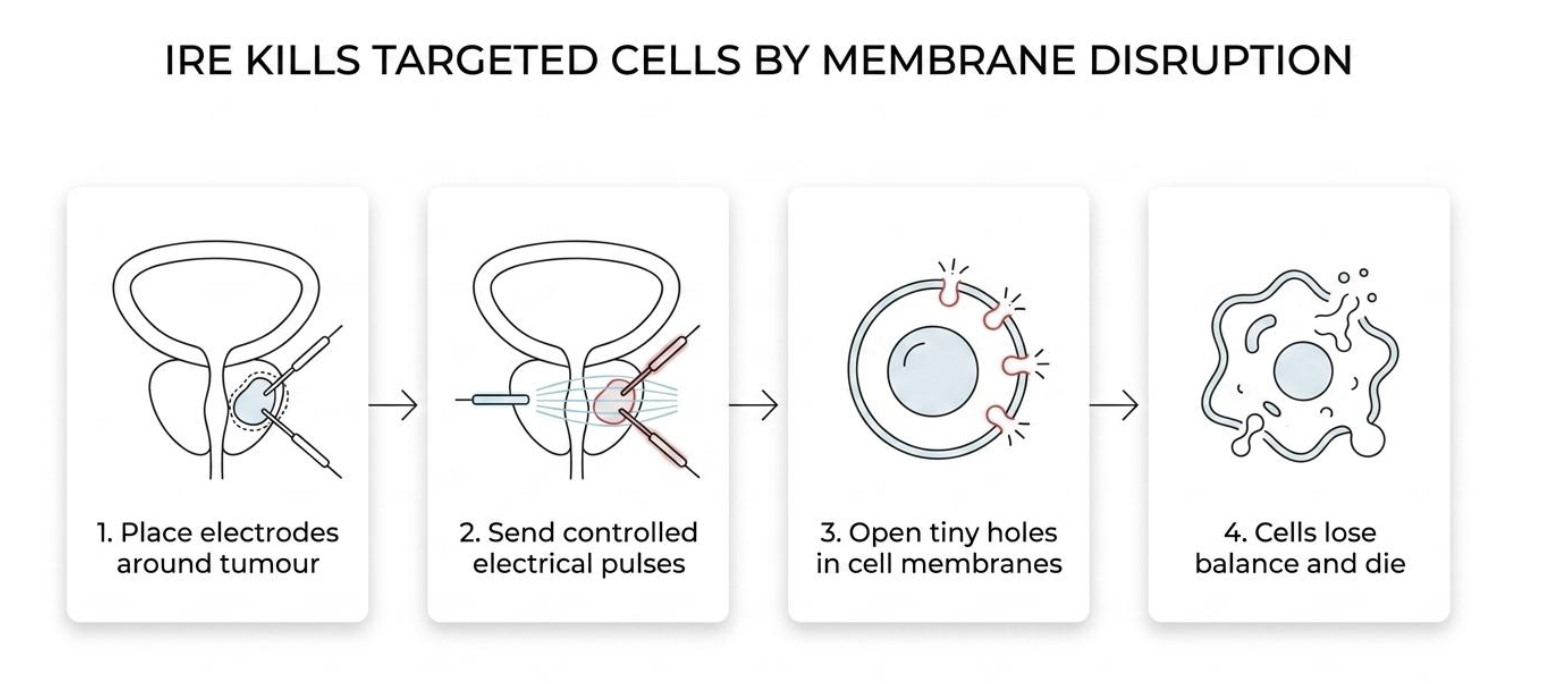
The mechanism of NanoKnife is fundamentally different from surgery, HIFU, cryotherapy, and radiotherapy. It does not cut, heat, freeze, or irradiate the target tissue. Instead, it uses controlled electrical pulses to kill cancer cells by disrupting their cell membranes.
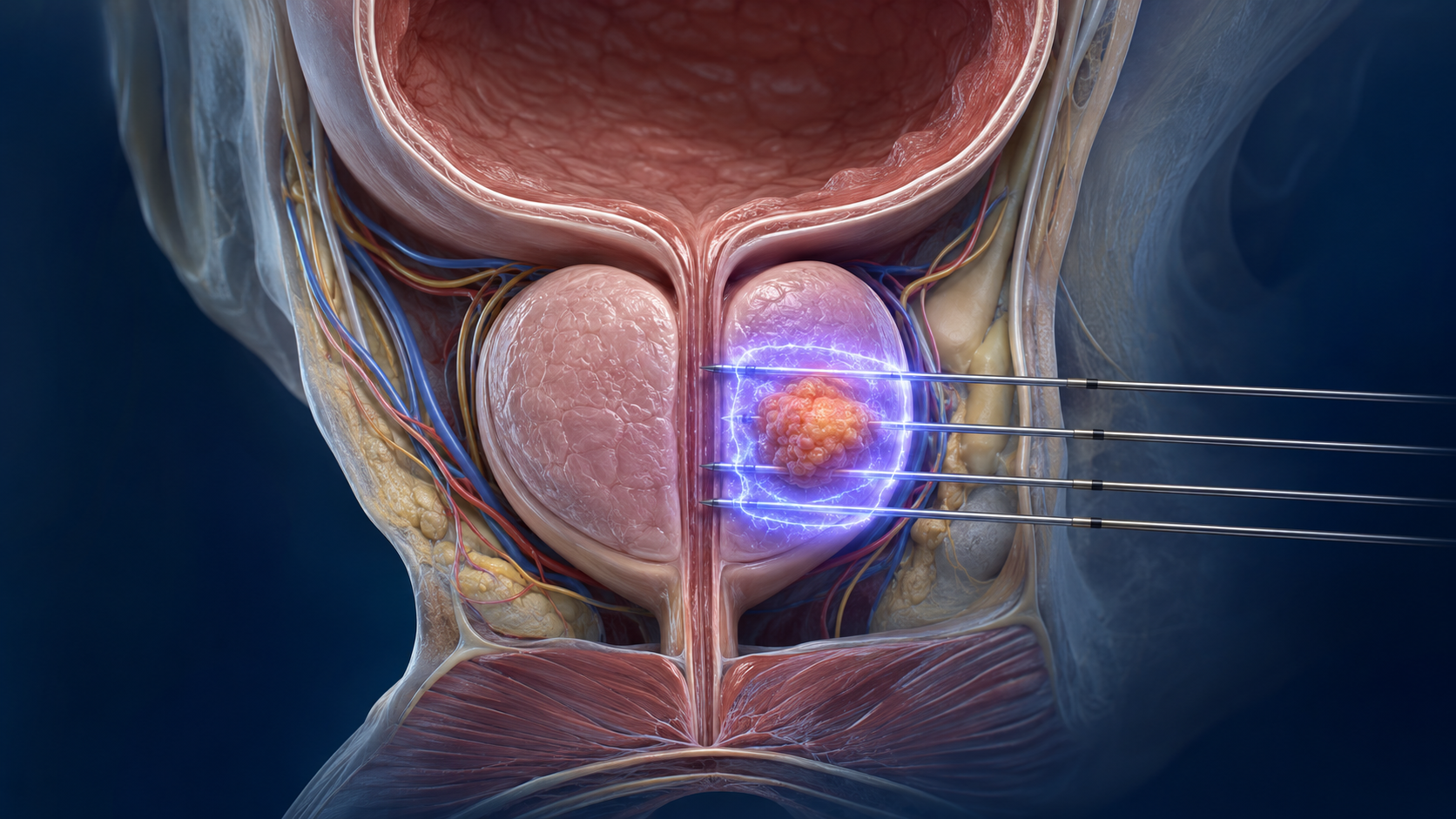
During treatment, thin electrodes are placed into and around the target area within the prostate under imaging guidance. Short bursts of high-voltage, low-energy electrical current are then delivered between those electrodes in a precisely calibrated sequence. The electrical field created between the electrodes affects the membranes of the cells within the treatment zone.
The pulses create tiny permanent openings — often described as nanopores — in the cell membranes of the targeted tissue. When enough nanopores accumulate, the cells can no longer maintain their internal environment. Normal homeostatic mechanisms fail, and the cells die. This process is called irreversible electroporation, which is where the clinical name comes from.
| Step | What happens | Why it matters |
|---|---|---|
| Electrode placement | Thin electrodes positioned in and around the cancer target zone transperineally | Defines the treatment field precisely |
| Pulse delivery | Short high-voltage pulses pass between the electrodes through the tissue | Affects cell membranes in the planned field only |
| Nanopore formation | Tiny permanent pores form in the membranes of targeted cancer cells | Cells lose structural and functional integrity |
| Homeostasis failure | Cells can no longer maintain internal balance | Cancer cells die — non-targeted cells outside the field are unaffected |
| Tissue clearance | Treated cells gradually cleared by the body's normal processes | The ablated zone resolves over weeks; PSA falls reflecting this |
Why the non-thermal mechanism matters
The fact that IRE does not rely on heat or cold is clinically significant. Thermal ablation methods — HIFU, cryotherapy, and radiofrequency ablation — all carry a risk of thermal spread: heat or cold may propagate beyond the intended treatment zone and potentially affect adjacent structures. The urethra, neurovascular bundles, and rectum all sit close to the prostate.
IRE's non-thermal mechanism means the electrical field acts on cell membranes without generating significant heat in the surrounding tissue. Connective tissue scaffolding — including the structural framework of blood vessels and nerves — is thought to be largely preserved within the treatment zone, even as the cells within it are destroyed. This is one of the theoretical advantages that has driven interest in IRE for tumours located close to the neurovascular bundles or the urethra, where thermal methods carry higher risk.
That said, "non-thermal" does not mean "no risk to adjacent structures." Electrode placement, pulse calibration, and prostate anatomy all influence what the treatment field actually affects. The non-thermal claim is a mechanistic property of the technique — not a guarantee of functional preservation in every case.
What happens during NanoKnife treatment for prostate cancer
Before any treatment decision, the cancer must be mapped as accurately as possible. Focal therapy only works when the target is well defined — and for NanoKnife, that means high-quality multiparametric MRI, targeted transperineal biopsy results, and careful review of where the cancer sits within the gland relative to critical structures.
Mr Sri offers NanoKnife/IRE assessment alongside the full range of prostate cancer treatment options — surgery, HIFU, radiotherapy, and active surveillance. Same-week appointments available.
Who is a realistic candidate for NanoKnife
IRE is considered for men with clinically localised prostate cancer where imaging and biopsy together suggest the disease is genuinely confined to a defined area of the gland. The key criteria that support a discussion about NanoKnife are broadly similar to those for other focal therapies, with some important practical differences.
- Localised prostate cancer — no evidence of extracapsular extension or nodal involvement
- Grade Group 2 or selected Grade Group 3 — intermediate risk in a confined, well-defined area
- Single dominant lesion clearly visible on multiparametric MRI
- Systematic biopsy of the whole gland confirming no significant contralateral disease
- Tumour location close to the neurovascular bundles or urethra — where the non-thermal approach has theoretical advantages over HIFU or cryotherapy
- Genuine commitment to structured follow-up including repeat biopsy at 12–18 months
Bilateral significant disease, Grade Group 4 or 5 cancer, extracapsular extension, inability to commit to follow-up surveillance, or a prostate anatomy that makes electrode placement unreliable all limit or exclude NanoKnife. The fact that IRE preserves connective tissue architecture does not make it appropriate for more advanced or widespread disease — the oncological priority always takes precedence.
Selection also involves broader clinical judgment. A patient's age, general health, existing urinary function, prior pelvic treatment, and personal values around the trade-off between certainty of cancer control and functional preservation all legitimately shape the recommendation. A man who wants the strongest possible long-term cancer control assurance is likely better served by robotic radical prostatectomy. A man with intermediate-risk unilateral disease who places high priority on functional preservation and is prepared for close follow-up may find IRE well matched to his situation.
Benefits and trade-offs — the honest picture
- Non-thermal mechanism — may better preserve vascular and nerve architecture near the treatment zone
- Treats the cancer-bearing zone rather than the whole prostate
- May reduce continence and erectile function disruption compared with whole-gland treatment in selected cases
- Shorter recovery than radical surgery — typically days rather than weeks
- Leaves salvage treatment options open if recurrence occurs
- NICE-recognised: within the treatment landscape for localised prostate cancer
- Higher re-treatment rate than radical surgery — broadly 20–30% at 5 years across focal modalities
- Untreated prostate tissue remains — PSA monitoring and repeat biopsy are mandatory
- Evidence base is growing but follow-up data shorter than for surgery or radiotherapy
- General anaesthetic required with cardiac synchronisation — not a minor procedure
- Urinary catheter typically in place for 1–2 weeks post-procedure
- NICE requires special governance, consent, and audit arrangements
What NICE says about NanoKnife/IRE for prostate cancer
In the UK, NICE has stated that irreversible electroporation for prostate cancer should be used with special arrangements for clinical governance, patient consent, and audit or research. In plain terms, it is recognised as a treatment within the prostate cancer landscape, but not as a routine standard option for all patients.
That NICE position reflects the current evidence landscape honestly. There is growing clinical experience, improving technical quality, and encouraging outcomes data from specialist centres. Long-term comparative data — the kind that would allow a clear head-to-head comparison with surgery or radiotherapy over ten or fifteen years — are still being built.
For patients, the NICE position should not be read as a negative verdict. It means NanoKnife/IRE is best considered in a setting with high-quality imaging infrastructure, experienced operators, transparent consent, and a follow-up plan that is taken seriously — exactly the conditions in which focal therapy produces its best results.
Follow-up after NanoKnife — why it cannot be treated as optional
Because part of the prostate remains in place after IRE, the surveillance plan after treatment is as important as the treatment itself. PSA does not fall to undetectable levels after focal therapy — the untreated tissue continues to produce it. That makes follow-up more nuanced than after radical prostatectomy, and more demanding than some patients initially expect.
A standard follow-up protocol after NanoKnife typically includes PSA measurement at 3, 6, and 12 months, then six-monthly thereafter; multiparametric MRI at 6–12 months to assess the ablation zone and the preserved gland; and targeted transperineal biopsy at 12–18 months — even in the absence of PSA rise or imaging concern. Further biopsy is indicated if PSA trends suggest recurrence or if MRI identifies new suspicious areas.
Men who genuinely cannot commit to this surveillance schedule are not well suited to focal therapy, regardless of how appealing the treatment sounds. The follow-up is not an afterthought — it is built into what focal therapy is designed to do.
Mr Denosshan Sri — MA Cantab · MB BChir · FRCS (Urol)
Consultant Urological Surgeon at St George's University Hospital, subspecialising in prostate and kidney cancer. Mr Sri offers NanoKnife/IRE assessment as part of the prostate cancer treatment planning consultation at four London private hospitals. He discusses focal therapy, robotic prostatectomy, radiotherapy, and active surveillance at every prostate cancer consultation — providing evidence-based guidance on which option is best matched to each patient's disease, anatomy, and priorities. Full profile and publications →
Considering NanoKnife or other prostate cancer treatment options?
Mr Sri offers NanoKnife/IRE assessment alongside the full range of prostate cancer treatment options at four London private hospitals. Honest, evidence-based guidance on which approach is best matched to your specific cancer. Same-week appointments. No GP referral required.