
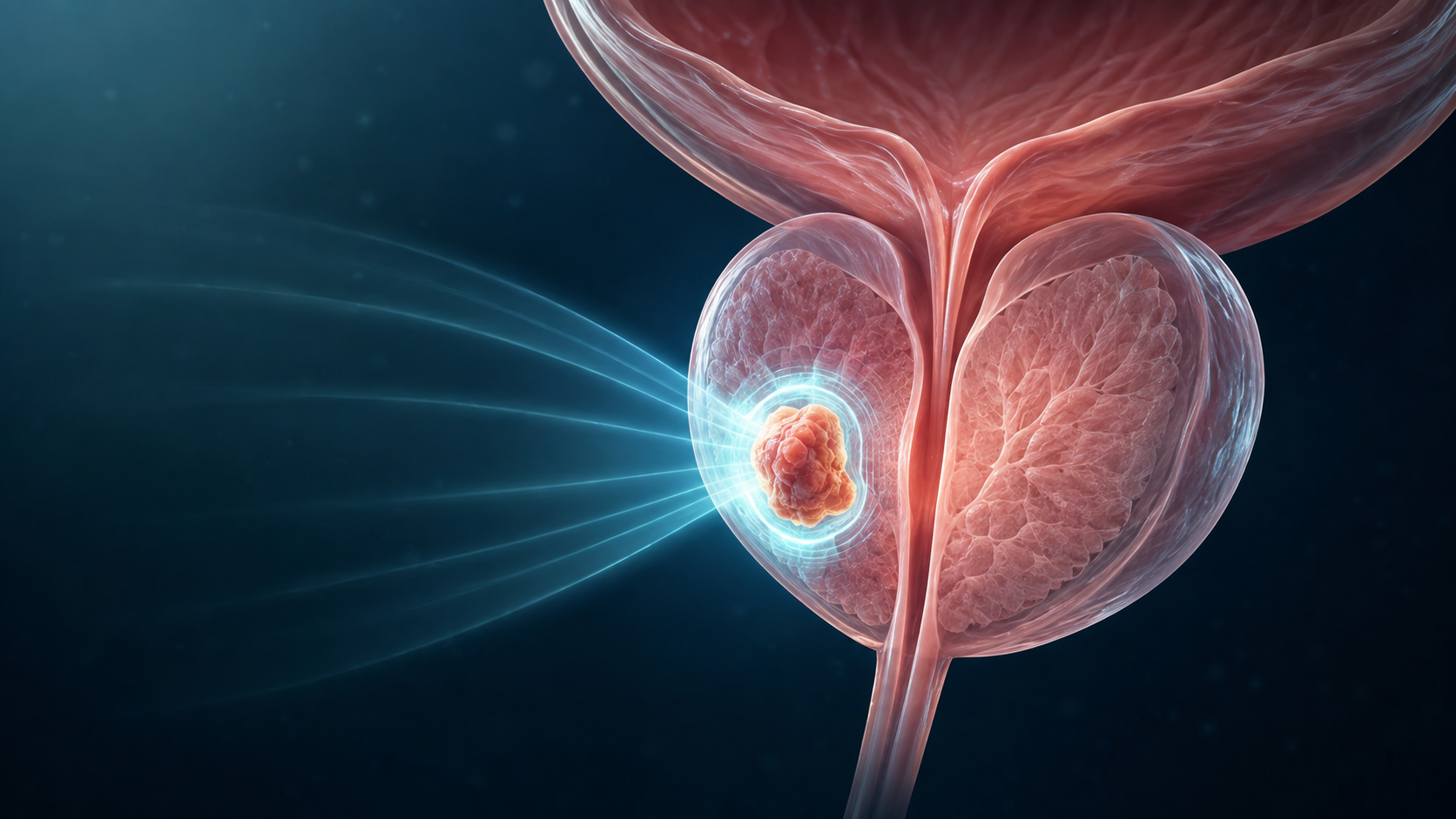
Focal Therapy Explained — HIFU, IRE/NanoKnife and Cryotherapy
Focal therapy targets only the cancer-bearing zone of the prostate, leaving the rest of the gland in place. For carefully selected men, it may offer meaningful functional advantages over whole-gland treatment — though it comes with its own profile of trade-offs that deserve an honest discussion.
For many men with localised prostate cancer, the treatment choice is not simply about removing or destroying cancer. It is also about what life may look like afterwards — particularly in relation to urinary control, erections, and the realistic possibility of needing further treatment later on.
Focal therapy sits in that space between active surveillance and whole-gland treatment. Rather than treating the entire prostate, it aims to destroy only the area known to contain the most significant cancer. That makes it appealing. It also explains why the conversation around it needs to be careful and balanced — because focal therapy is not a softer version of established curative treatments. It is a different approach with a different risk profile, different follow-up requirements, and a maturing evidence base.
Focal therapy has genuine advantages for the right patient — but those advantages come with an ongoing monitoring commitment and a higher chance of needing further treatment than radical prostatectomy or whole-gland radiotherapy. Understanding both sides of that balance is essential before making a decision.
The basic principle — what focal therapy is trying to do
Focal therapy is a prostate-sparing treatment approach. The idea is to identify the main cancerous area within the prostate, target that area precisely, and leave the rest of the gland undisturbed.
This is different from radical prostatectomy, which removes the prostate entirely, and from radiotherapy aimed at the whole gland. It is also different from active surveillance, where treatment is deferred while the cancer is closely monitored.
The attraction is clear. If less tissue is treated, there may be less disruption to the structures linked to continence, erections, and bladder function. That is the main reason focal therapy has drawn sustained attention over the past decade.
What it does not yet offer is the same level of long-term certainty that comes with more established curative treatments. Guidelines and systematic reviews consistently describe focal therapy as an option for carefully selected men with localised disease — not as a universal replacement for surgery or radiotherapy.
Patient selection — why this matters more than almost anything else
Selection matters more here than with almost any other prostate cancer treatment. Focal therapy is usually considered when cancer appears confined to the prostate and concentrated in one main area — or in a small number of clearly defined areas, often on one side of the gland. In practice, that usually means lower-volume low- or intermediate-risk disease.
A man may appear suitable on PSA alone and still not be suitable once MRI and biopsy findings are fully reviewed. Prostate cancer is often multifocal — more than one separate cancer focus can exist within the gland. If clinically significant disease is present outside the planned treatment zone, focal therapy may miss it. That is the fundamental risk inherent in any prostate-sparing approach.
Before treatment, clinicians typically rely on multiparametric MRI and targeted transperineal biopsy, usually alongside systematic sampling of the whole gland, to map the cancer as accurately as possible. Even with high-quality imaging and biopsy, mapping is not perfect.
Focal therapy cannot safely treat the whole prostate focally — by definition it leaves untreated tissue behind. If clinically significant cancer is present on both sides of the gland, or in multiple zones, a focal approach will miss disease. This is why systematic biopsy of the entire gland, not just targeted sampling of the MRI-visible lesion, is essential before the treatment is offered.
Often considered: localised prostate cancer, limited tumour volume, MRI-visible disease on one side, Grade Group 2 or selected Grade Group 3, PSA typically below 15–20 ng/mL.
Less suitable: extensive bilateral disease, higher-risk features, cancer extending beyond the prostate capsule, tumours that cannot be mapped with confidence, or men unable to commit to rigorous follow-up surveillance.
Also relevant: age, general health, current urinary and sexual function, and each man's own view of the trade-off between function preservation and cancer-control certainty.
HIFU, NanoKnife and Cryotherapy — how the three main methods differ
All three focal methods aim to ablate prostate tissue — to destroy the cancer-bearing zone precisely while sparing the surrounding structures. They differ in the energy source, the mechanism of tissue destruction, and the practical logistics involved.

| Treatment | How it works | Main practical point | Potential advantage | Main limitation |
|---|---|---|---|---|
| HIFU | Ultrasound heats and destroys tissue | Delivered via the rectum — no incision | Day case; well-known focal option; largest dataset | Heat can affect nearby structures; long-term comparative data limited |
| NanoKnife / IRE | Electrical pulses disrupt cell membranes | Needles placed into the prostate transperineally | Non-thermal — may better preserve nerve/vessel architecture | Evidence base still developing; follow-up often short |
| Cryotherapy | Freezing cycles destroy tissue | Probes inserted into the prostate | Established — used in focal and salvage settings | Freezing must be controlled carefully to avoid off-target damage |
How focal therapy is planned and monitored
The technology tends to get the attention, but planning and follow-up are just as important as the treatment itself.
A focal therapy pathway starts with imaging and biopsy review. The goal is to define the clinically significant cancer, decide whether it can be targeted safely, and judge whether a focal approach is proportionate. Some men who initially ask about focal therapy are advised that active surveillance would be more appropriate. Others are advised that surgery or radiotherapy would offer a more dependable long-term cancer-control strategy. The conversation is honest in both directions.
After treatment, monitoring continues — and this is a key difference from radical prostatectomy. After prostatectomy, PSA should fall to an undetectable level, providing a clear surveillance signal. After focal therapy, PSA is still produced by the remaining untreated prostate tissue. That makes monitoring more nuanced.
- Before treatment: multiparametric MRI, transperineal biopsy with systematic sampling, tumour mapping, and a full discussion of alternatives
- During treatment: energy delivered only to the selected prostate zone, under imaging guidance
- After treatment: PSA monitoring at regular intervals, repeat MRI at 6–12 months, repeat biopsy at 12–18 months — not optional
Mr Sri offers focal therapy assessment alongside the full range of prostate cancer treatment options. Same-week appointments available.
What the evidence shows — outcomes, side effects and the limits of certainty
This is where balance becomes most important — and where the honest picture differs most from the marketing around focal therapy.
The strongest case for focal therapy is functional preservation. A 2024 systematic review and meta-analysis reported encouraging average outcomes for most men:
Those figures are genuinely encouraging, though they need context. Better average function does not mean no risk — some men do lose erectile function, some develop urinary symptoms, and some require a catheter for a period after treatment. Results vary substantially with baseline function, tumour location, and the specific technique used.
The harder question is cancer control over the long term. A separate 2024 review identified 49 focal therapy cohorts treated between 2008 and 2024 — including 21 cryotherapy studies, 20 HIFU studies, and 8 IRE studies. Median follow-up across those cohorts ranged from just 6 to 63 months. That range tells its own story: much of the available evidence is short- to mid-term, not the decades-long data that exist for surgery and radiotherapy.
The European Association of Urology has been clear that the lack of long-term prospective comparative studies limits how far focal approaches can yet be treated as equivalents to established curative treatments. NICE lists HIFU, cryoablation, and irreversible electroporation as recognised options within the treatment landscape for localised prostate cancer — and that recognition matters — but it is not the same thing as saying every suitable-looking patient should choose focal therapy over surgery or radiotherapy.
Focal therapy vs surgery, radiotherapy and surveillance
Focal therapy is often described as a middle ground, and that framing is broadly fair — but the middle-ground label can make it sound like an easy compromise. It is not.
A simple way to frame the trade-off honestly:
- Less tissue treated — potentially better short-term functional outcomes
- More prostate left in place — no surgical removal required
- Day-case or minimal overnight stay for most patients
- Greater chance of needing ongoing testing — PSA monitoring and repeat biopsy are mandatory, not optional
- Higher re-treatment rate than radical prostatectomy — broadly 20–30% at 5 years across modalities
- Less long-term cancer-control certainty — particularly beyond 5 years
- Salvage treatment is possible but can be more complex than first-line whole-gland treatment
For men with low-risk disease, active surveillance may still be the most proportionate choice — it avoids treatment entirely while the cancer is closely monitored. For men with intermediate-risk, unilateral disease, focal therapy may offer a meaningful alternative to whole-gland treatment, with better early functional outcomes in exchange for a higher re-treatment rate. For men with high-risk or bilateral disease, surgery or radiotherapy remain the stronger evidence-based options for durable cancer control.
Choosing between these approaches requires a frank, individual conversation — not a comparison of marketing materials. The right treatment depends on cancer characteristics, biopsy findings, prostate anatomy, personal priorities, and how a man weighs the functional trade-off against the cancer-control certainty he wants.
Follow-up after focal therapy — why it cannot be optional
No one should choose focal therapy expecting the clinical story to end on the treatment day.
Follow-up is part of what focal therapy is. PSA tests continue. MRI is repeated — typically at 6–12 months to assess the ablation zone. Biopsy is recommended at 12–18 months, and again if PSA trends or imaging raise concern. That monitoring is not a sign that something has gone wrong. It is how focal therapy works as a treatment pathway.
There is also a realistic chance of further treatment. A man may need repeat focal ablation, or later move to surgery or radiotherapy if residual or recurrent clinically significant cancer is identified. That is not a failure of focal therapy — it is part of its known profile. But it does mean that choosing focal therapy requires genuine willingness to engage with ongoing surveillance for at least five years, and ideally longer.
Men who find repeat biopsy intolerable or whose circumstances make regular MRI impractical are not well suited to this approach, regardless of how favourable their selection imaging appears. The follow-up commitment is not a minor consideration — it is a core part of what focal therapy requires.