
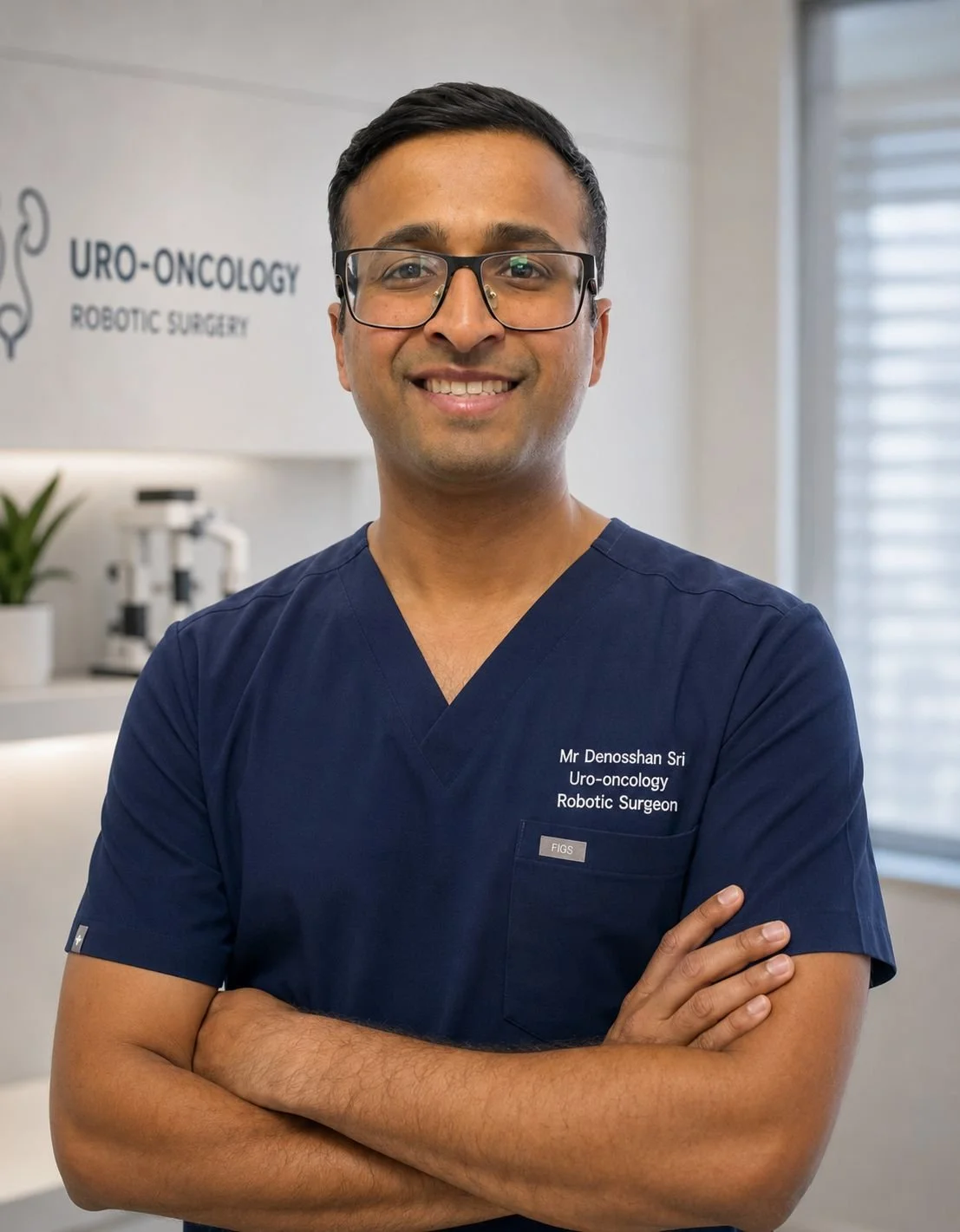
Mr Denosshan Sri
A high-volume robotic urological surgeon specialising in kidney and prostate cancer, minimally invasive urology, and complex upper tract reconstruction. One of a select group of European surgeons performing retroperitoneal robotic partial nephrectomy as a default approach.
Specialist expertise built on an exceptional foundation
Mr Sri graduated from the University of Cambridge with a double first in Medicine and was awarded Distinction. He completed his higher specialist urological training in South West London, before undertaking a highly competitive post-CCT fellowship in robotic kidney cancer surgery at Frimley Park Hospital — one of the UK's foremost robotic centres. He was appointed Consultant Urologist at St George's University Hospital in October 2021, one of London's largest trauma and tertiary referral centres, where he leads the kidney cancer service across the South West London referral network.
His subspecialty focus is robotic kidney and prostate cancer surgery, with a particular emphasis on nerve sparing robotic radical prostatectomy & nephron-sparing kidney surgery. He is among a small group of surgeons in Europe who perform robotic retroperitoneal partial nephrectomy — approaching the kidney from behind, without entering the bowel cavity. He introduced this technique to South West London, where it is now established as the regional standard of care for kidney cancer surgery. He accepts tertiary and quaternary referrals for tumours declined for kidney-preserving surgery at other centres.
In addition to nerve-sparing radical prostatectomy for prostate cancer, his robotic practice also encompasses robotic pyeloplasty, ureteric reimplantation, robotic adrenalectomy, nephroureterectomy, and robotic reconstruction. He manages a full range of benign urological conditions and offers the complete range of minimally invasive BPH treatments including Rezum, Aquablation, HoLEP, GreenLight laser, and TURP.
He retains a broad scope of NHS practice at St George's & Kingston Hospital, contributing to both benign and cancer multidisciplinary team meetings, and serves as Urological Trauma Lead across the SWL trauma network.
Current positions of clinical leadership
Results that speak for themselves
Outcomes data from Mr Sri's audited robotic series (up to year end 2025)
Why patients are referred to Mr Sri
Mr Sri accepts tertiary and second opinion referrals from both patients and clinicians across South West London and nationally. Below are the most common reasons for specialist referral in his two core subspecialties.
-
Retroperitoneal robotic expertise One of a small group of European surgeons performing retroperitoneal robotic partial nephrectomy as the default approach
-
Nephron-sparing for challenging tumours Accepts referrals for complex, high RENAL score tumours declined for kidney-preserving surgery elsewhere. 48% of cases are RENAL score >10
-
Second opinion — surveillance or nephrectomy recommended Patients who have been advised to proceed to radical nephrectomy or continue surveillance, but wish to explore kidney-preserving options
-
Prior abdominal surgery The retroperitoneal approach avoids the peritoneal cavity, making it particularly suitable for patients with previous abdominal operations
-
Solitary kidney tumours Where preserving every unit of renal function is critical, nephron-sparing surgery is the priority — however technically demanding
-
High BMI patients The retroperitoneal approach provides a direct route to the kidney, with advantages in obese patients where transperitoneal access is more complex
-
High-volume robotic pelvic surgeon 200+ robotic procedures annually, with >90% continence at one year (nerve spare) and 0% conversion to open surgery across his series
-
Nerve-sparing expertise Meticulous nerve-sparing technique prioritising functional outcomes — urinary control and potency — alongside oncological control
-
High-risk and locally advanced prostate cancer Principal Investigator for SWL in the ELLIPSE RCT — experience with T3 and high-risk disease, including extended lymph node dissection
-
Tertiary referral role within SWL Network Cancer Lead @ St George's Hospital
-
RCS Fellowship Trainer in RARP Leads the only RCS-accredited robotic fellowship in South West London — a marker of surgical standards recognised by the Royal College of Surgeons
-
Second opinion before radiotherapy Patients considering radiotherapy who wish to discuss surgical options, or where treatment choice is finely balanced, are welcome for an expert surgical opinion
Selected urological publications
Full list on PubMed.
Training the next generation of robotic surgeons
Mr Sri leads the RCS-accredited robotic surgical fellowship at St George's University Hospital — one of very few such programmes in the UK to hold Royal College of Surgeons accreditation. The fellowship trains surgeons in robotic partial nephrectomy, radical prostatectomy, reconstructive upper tract and pelvic surgery, robotic adrenalectomy, and robotic female urology.
He mentors consultant colleagues from across the UK and internationally in robotic techniques, regularly teaches at national and international urology courses, and serves as a faculty member and speaker at conferences including the FRCS Urology examination course.
Mr Sri serves as Principal Investigator for clinical surgical trials at St George's Hospital:
Training & appointment
Ready to book a consultation?
Same-week appointments at three London private hospitals. No GP referral required. Self-pay and all major insurers accepted.