
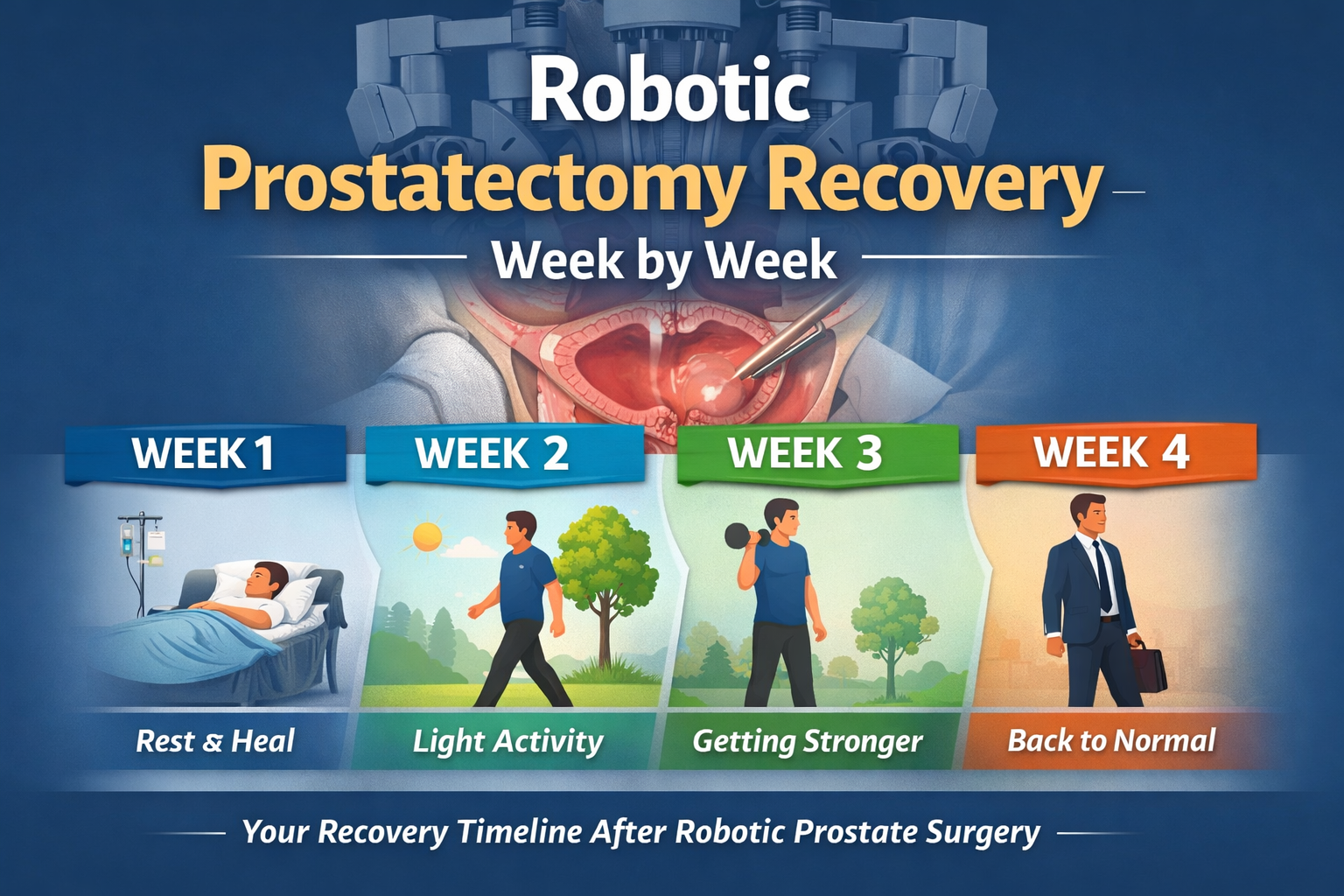
Recovery after robotic prostatectomy is rarely a straight line. Most men improve steadily, yet the pace can feel uneven from one week to the next. A good recovery plan makes room for the practical issues — catheter care, pain control, walking, pads, and sleep — while also making space for the bigger questions about PSA results, erections, continence, and confidence.
The encouraging part is that there is a recognisable pattern. While every patient's timeline differs, especially with age, fitness, nerve-sparing status, diabetes, body weight, and cancer stage, there are milestones that help make the first two months feel more manageable.
Pelvic floor training should start 4–6 weeks before the operation. Patients who begin pelvic floor exercises before surgery recover continence faster than those who start only after catheter removal. Mr Sri refers all prostatectomy patients for specialist pelvic floor physiotherapy pre-operatively. Pelvic floor guide from Prostate Cancer UK →
What nerve-sparing means, how the da Vinci robot makes it possible, and what continence recovery after prostatectomy looks like — explained by Mr Sri before the week-by-week guide below.
Full procedure guide →The first 7 days
The first few days are usually more controlled than many people expect. Most patients spend one or two nights in hospital, mobilise within hours of surgery, and go home with oral pain relief. Pain is often at its worst immediately after the operation and can still peak during the first three days, but it commonly settles quickly after that.
A urinary catheter is standard after surgery and usually stays in place for 7 to 14 days. That catheter can feel like the centre of life for a while — walking, sitting, sleeping, and washing all seem to revolve around it. Even so, early movement matters enormously. Gentle walking reduces the risk of blood clots, helps bowel function return, and often improves confidence as much as it improves circulation.
Fatigue is common, even when the wounds look small. Robotic surgery uses small incisions, but the body still has to recover from a major internal operation.
In that first week, the recovery plan focuses on a few simple priorities:
- Short walks several times a day
- Catheter care and good hydration
- Pain relief taken as prescribed
- Preventing constipation
- Rest without complete bed rest
Emotionally, this week can feel strangely suspended. The cancer has been treated, yet the first real sense of recovery often does not begin until the catheter comes out.
Weeks 2 to 4
For many men, this is the most frustrating stretch. The catheter is usually removed around day 7 to 10, and that is often when urinary leakage becomes obvious. Leakage after catheter removal is expected — it can be heavy at first, especially on standing, coughing, walking, or changing position. Pads are usually needed full time in the early stage.
Pelvic floor muscle training becomes central at this point. Good technique matters more than brute effort — a specialist pelvic floor physiotherapist can be very helpful, especially if there is uncertainty about whether the correct muscles are being activated.
Pain from the operation itself is often modest by the second week, but tiredness may linger longer than expected. Many patients feel physically better than they do mentally. The shock of cancer treatment starts to settle, but worries about leakage, pathology results, and erections often become louder. That reaction is common and does not mean recovery is going badly.
Driving is usually delayed until the catheter is out, pain is controlled, and an emergency stop would be safe. Desk-based work may be possible by weeks 3 to 4 for many patients, though heavy lifting and strenuous activity are still off limits.
Weeks 4 to 8
By the second month, most men begin to feel more like themselves. Walking is easier, stamina starts to return, and day-to-day independence improves. Continence often improves during this period too, though not always in a smooth pattern — one week may feel much better, then the next can be disappointing, especially with increased activity.
This is also when follow-up shifts from surgical recovery to survivorship. The first PSA test is often done around 6 to 12 weeks, wound healing is reviewed, continence progress is discussed, and plans for erectile rehabilitation may begin if healing is on track.
| Time after surgery | What often happens | What to expect |
|---|---|---|
| Days 0–2 | Hospital stay, catheter in place, early walking | Mild to moderate pain, tiredness, nursing support |
| Week 1 | Home recovery, catheter care | Short walks, simple meals, rest, minimal driving or lifting |
| Week 2 | Catheter often removed | Leakage begins, pads needed, pelvic floor work becomes essential |
| Weeks 2–4 | Gradual increase in activity | Less wound discomfort, fatigue still common, office work may be possible |
| Weeks 4–6 | Follow-up review, first PSA planning | Better mobility, improving confidence, ongoing pad use |
| Weeks 6–8 | Return towards regular routines | Reduced leakage for many men, light exercise often resumes |
Questions about your recovery?
Mr Sri offers structured post-operative follow-up covering PSA surveillance, continence, and sexual rehabilitation. Same-week appointments available.
PSA surveillance and survivorship
After the prostate has been removed, PSA becomes the most important blood test in follow-up. The expectation is that PSA will fall to an undetectable or very low level within the first month or two. That first result matters because it sets the baseline for long-term surveillance.
Most follow-up schedules use PSA every 3 to 6 months in the early years, then less often if results remain stable. Routine scans are not usually needed when PSA is undetectable and there are no new symptoms.
Waiting for PSA results can bring a sharp burst of anxiety — often called scanxiety. Many men feel physically well but become tense in the days before the test. Clear follow-up plans and knowing who to contact can reduce a surprising amount of this distress.
- First PSA: usually checked at 6 to 12 weeks after surgery
- Ongoing PSA: often every 3 to 6 months, then spaced out if stable
- Imaging: reserved for a rising PSA or new symptoms
- Rising PSA: prompts discussion about recurrence and whether early salvage treatment is needed — early detection is why follow-up is never a formality
Penile rehabilitation and erectile recovery
Erectile dysfunction after prostatectomy is common, even after excellent surgery. The erectile nerves are delicate — even when they are spared, they may be bruised and slow to recover. Recovery can take many months, and sometimes longer than a year.
Penile rehabilitation aims to preserve tissue health and support the best possible return of erections. It usually starts once healing is secure, often around 4 to 6 weeks. Common early options include PDE5 inhibitors such as sildenafil or tadalafil, used either regularly or on demand.
Vacuum erection devices can also be useful — by drawing blood into the penis, they may help maintain oxygenation and reduce tissue changes that follow a prolonged period without erections. Some men move on to injection therapy if tablets are not sufficient. Penile prosthesis surgery remains a very effective later option when simpler treatments have not succeeded.
Recovery of sexual function is not only about erections. Desire, confidence, intimacy, orgasm, and partner communication all matter. Orgasm is still possible for many men after prostatectomy, though it is dry because the prostate and seminal vesicles have been removed. That change deserves open discussion — not just at one appointment, but throughout the follow-up period.
- Tablets (sildenafil or tadalafil): started when healing allows, often 4–6 weeks post-op
- Vacuum erection device: regular use to support tissue health
- Injection therapy: a stronger option when tablets are not sufficient
- Partner support: communication and patience are part of the rehabilitation
- Prosthesis surgery: a reliable later option when other treatments have failed
Urinary continence recovery
Leakage is usually worst just after catheter removal, then improves gradually over weeks and months. Many men move from several pads a day to one or two for reassurance, then eventually to no pads at all. That improvement can continue for 6 to 12 months, sometimes longer.
Pelvic floor exercises remain first-line treatment. They work best when taught properly and practised consistently, not frantically — overworking the muscles can be counterproductive. Some men also benefit from bladder training, especially if urgency and frequency become prominent as the bladder readjusts after surgery.
Not all leakage is the same. Stress leakage happens with movement, coughing, or lifting. Urgency leakage is driven by a sudden urge to pass urine. If urgency is prominent, medication may help alongside pelvic floor rehabilitation.
For persistent bothersome leakage after several months, specialist assessment can lead to further intervention — including a male sling or artificial urinary sphincter for the right patient. A slower recovery does not mean permanent failure.
- Regular pelvic floor practice — technique over quantity
- Avoiding constipation
- Spreading fluid intake evenly across the day
- Using pads without shame while recovery continues
- Reviewing caffeine and alcohol if urgency is troublesome
Emotional recovery
The physical milestones are easier to measure than the emotional ones. Fear of recurrence, anger about side effects, embarrassment about leakage, and grief over sexual change are all common reactions. Some men feel better simply knowing these reactions are normal. Others benefit from more active support — whether from a partner, cancer nurse specialist, physiotherapist, support group, or counsellor. Asking for help is part of recovery, not a sign that recovery has gone off course.
Questions to bring to your follow-up appointments
Appointments tend to go better when patients arrive with specific questions rather than trying to remember everything in the room. Useful questions include:
- How often should my PSA be checked from here, and what number should concern us?
- Is my continence recovery on the expected track for my age and nerve-sparing status?
- Would dedicated pelvic floor physiotherapy help me more at this stage?
- When should penile rehabilitation begin, or change?
- What level of ongoing leakage or erectile difficulty should prompt a specialist review?
- When can I safely return to gym work, cycling, or sex?
Recovery after robotic prostatectomy is not only about healing from an operation. It is also about building a steady, informed survivorship plan — with PSA surveillance, continence work, sexual rehabilitation, and the confidence to keep asking what comes next.