
Many people hear the word biopsy and immediately think of pain, risk, and bad news. That reaction is completely understandable. When the biopsy is for the prostate, anxiety often rises another notch because the area feels private, sensitive, and difficult to picture.
A transperineal prostate biopsy is now widely used because it samples prostate tissue with a lower infection risk than older methods. For most patients, the main surprise is a welcome one: it is usually considerably more manageable than they expected.
For most patients, a transperineal biopsy is uncomfortable rather than truly painful. The procedure is brief, controlled, and performed by a clinical team for whom it is routine. Anticipation is almost always worse than the procedure itself — and if pain control matters to you, there are options. Say so before the biopsy.
What is a transperineal prostate biopsy?
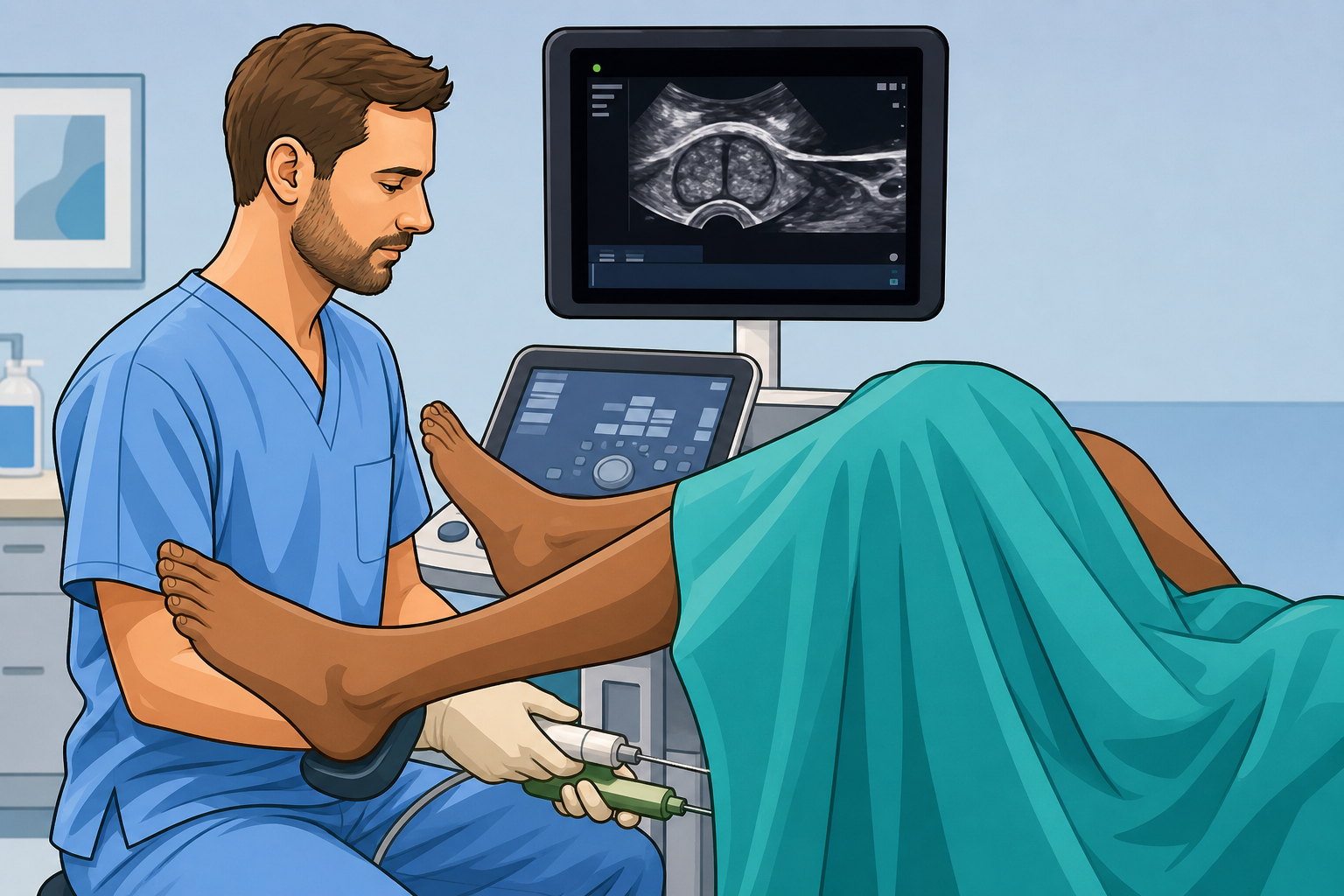
A transperineal biopsy takes small samples of tissue from the prostate gland. The biopsy needle passes through the skin between the scrotum and the back passage — an area called the perineum. Those samples are then examined under a microscope to check for prostate cancer or other changes.
This differs from the older transrectal approach, where the needle passes through the wall of the rectum. By entering through skin rather than bowel, the transperineal route avoids introducing bowel bacteria into the prostate — which is why it has become the recommended approach across most UK centres, and is now mandated as the preferred technique in updated NICE guidance.
The procedure is usually performed under local anaesthetic, sometimes with sedation added, and in some settings under a short general anaesthetic. The exact approach depends on the number of samples required, whether MRI-guided targeted sampling is planned, patient preference, and the centre's setup.
Why a biopsy may be recommended
Doctors do not recommend a prostate biopsy on the basis of a single result. The decision typically follows a combination of findings — PSA level, multiparametric MRI, digital rectal examination, and individual risk factors such as age, family history, and ethnicity.
A biopsy answers a precise question: is there cancer in the prostate, and if so, what type and grade is it? That distinction matters enormously because not all prostate cancers behave in the same way. Some require treatment promptly. Others can be monitored safely over years. Without tissue, that distinction cannot be made.
Common reasons a biopsy is recommended include:
- Raised or rising PSA level
- Suspicious area identified on multiparametric MRI (PIRADS 3, 4, or 5)
- Abnormal findings on digital rectal examination
- Monitoring a previously diagnosed low-risk cancer on active surveillance
- Re-checking after a previous biopsy with uncertain or incomplete results
How the procedure works — step by step
The appointment is usually planned in advance with specific instructions about eating, drinking, and medication. Blood thinners may need to be paused beforehand — but only under direct medical advice. Never stop prescribed medicines independently.
Does it hurt? A direct answer
Most patients describe a transperineal biopsy as uncomfortable rather than genuinely painful. Local anaesthetic significantly reduces the sharp component of the procedure. What people typically feel is pressure or pushing as the probe and needles are positioned, a brief stinging from the numbing injections themselves, and a snapping or clicking sensation as each sample is taken — which is the biopsy device firing.
For patients who opt for sedation or general anaesthetic, the experience feels easier still — often they are surprised by how little they recall or felt.
Pain is not identical for everyone. Anxiety, pelvic pain history, prostate size, the number of samples, and the type of anaesthetic all influence the experience. Some patients say the anticipation was far worse than the procedure. Others do find it unpleasant, but still brief and tolerable.
Afterwards, there is commonly a bruised or aching feeling in the perineum for a day or two. Simple over-the-counter pain relief is usually sufficient. Many patients return to desk-based work within a day.
The procedure is designed to be tolerated, not endured without support. If you are anxious about pain, say so explicitly before the appointment. Local anaesthetic technique can be optimised, sedation can be discussed, and the team can take extra time to explain each step as it happens. That conversation can make a real difference to the experience.
Recommended for a prostate biopsy?
Mr Sri offers targeted transperineal biopsy guided by multiparametric MRI. Same-week appointments available. No GP referral required.
Transperineal vs transrectal biopsy — the key differences
| Feature | Transperineal biopsy | Transrectal biopsy |
|---|---|---|
| Needle path | Through skin between scrotum and back passage | Through the rectal wall |
| Infection risk | Lower — no bowel entry | Higher — bowel bacteria introduced |
| Sepsis risk | Substantially lower | Higher — post-biopsy sepsis has driven shift to transperineal |
| Anaesthetic options | Local, sedation, or general anaesthetic | Usually local anaesthetic only |
| Prostate access | Excellent — including anterior zones often missed transrectally | Can miss anterior tumours |
| NICE recommendation | Preferred approach | No longer the recommended default |
| Recovery | Usually same-day, quick | Usually same-day, quick |
| Main short-term effects | Perineal soreness, blood in urine or semen, bruising | Similar — with greater infection concern |
What happens after the biopsy
Most patients go home the same day. After local anaesthetic alone, recovery is usually fast. After sedation or general anaesthetic, someone needs to accompany you home and stay with you for several hours.
It is normal — and expected — to see small amounts of blood in the urine, bowel movements, or semen afterwards. Blood in semen is particularly common and can persist for several weeks. This is not a sign that something has gone wrong. Mild perineal discomfort when sitting is also common for a short time after the procedure.
Most patients can return to desk-based work within one to two days. Heavy lifting, cycling, and vigorous exercise are best avoided until the soreness settles — usually within a few days to a week.
Results take days rather than hours. That waiting period is often harder than the biopsy itself, and is worth anticipating and planning for emotionally.
Side effects and when to seek urgent advice
Serious complications from transperineal biopsy are uncommon, and the switch away from the transrectal route has specifically reduced the most feared complication — post-biopsy sepsis. Even so, it is important to know which symptoms are expected and which need prompt attention.
Common and expected short-term effects:
- Mild perineal soreness and bruising for a few days
- Blood in urine — usually settles within days
- Blood in semen — can persist for several weeks and is normal
- Brief fatigue on the day of the procedure
These are uncommon but need prompt review — do not wait for a scheduled follow-up.
- Fever or shivering — possible infection requiring urgent assessment
- Difficulty passing urine — possible urinary retention
- Heavy bleeding or blood clots — more than the small amounts typically expected
- Severe or worsening pain — not settling with simple pain relief
- Feeling very unwell — especially in the first 48 hours after the biopsy
Contact the team who performed the biopsy, your GP, or attend A&E if you are seriously concerned. Contact Mr Sri's team →
How to prepare — practically and emotionally
Preparation is not only about medication and appointment logistics. It is also about reducing uncertainty, which is one of the most powerful drivers of procedural anxiety.
Practical preparation:
- Arrange transport — particularly if sedation or general anaesthetic is planned
- Wear loose, comfortable clothing to the appointment
- Confirm fasting instructions if sedation or general anaesthetic is involved
- Clarify which medications to stop and when to restart them — with your clinical team, not by assumption
- Mention any previous difficulty passing urine, as this is relevant to post-procedure monitoring
Emotional preparation: many patients keep their anxieties to themselves because they feel they should "just get on with it". Anxiety is useful clinical information — it is not a weakness to share it. Telling the team you are nervous allows them to adapt their approach, offer additional information, and consider whether sedation would help. A direct conversation before the procedure can significantly change the experience on the day.
Questions worth asking in advance:
- How many samples are likely to be taken, and will the biopsy be targeted, systematic, or both?
- Will it be under local anaesthetic, sedation, or general anaesthetic — and can I choose?
- How long will I be at the hospital?
- When can I drive, return to work, and resume exercise?
- When and how will I receive the results, and who will explain them to me?
What the biopsy results can show
A biopsy does more than return a yes or no answer. It can show benign tissue, atypical or suspicious cells that fall short of cancer, or cancer — and if cancer is present, it grades the aggressiveness of those cells using the Gleason system or the more recent Grade Group classification (1 to 5).
Grade Group 1 (Gleason 3+3=6) represents the least aggressive pattern, often manageable with active surveillance. Grade Group 5 (Gleason 9–10) represents the most aggressive, usually requiring prompt treatment. This grading, combined with PSA level, MRI findings, and clinical stage, forms the basis for every subsequent treatment discussion.
Sometimes the result is reassuring. Sometimes it opens a difficult but important conversation. In either case, it provides a firm clinical foundation for decision-making — far more reliable than blood tests or scans alone. The biopsy result is not a verdict. It is information that shapes what comes next.
When fear of pain should not delay a biopsy
Avoiding a recommended biopsy because of pain fears is understandable, but it can leave a serious question unanswered for longer than is safe. If a clinician has recommended a transperineal prostate biopsy after reviewing your PSA, MRI, and risk profile, the purpose is to get accurate information early and safely.
The modern transperineal approach exists specifically because it can sample the prostate thoroughly — including anterior zones that older transrectal biopsies often missed — while lowering infection risk. For the right patient, that is a meaningful improvement in both safety and diagnostic accuracy.
If you are anxious, the most productive response is a direct conversation about anaesthetic options and pain management — not avoidance. The realistic expectation, based on what most patients report, is this: it is brief, controlled, and uncomfortable in a way that the majority of men get through considerably better than they feared.