
A diagnosis of localised prostate cancer often opens a more nuanced conversation than people expect. Treatment is not always a binary choice between doing everything or doing nothing. In selected cases there is room for a more targeted approach — one that treats the cancer while leaving as much healthy prostate tissue as possible untouched.
That is where Focal One HIFU enters the picture. HIFU stands for high-intensity focused ultrasound, a method that uses sound waves to heat and destroy prostate tissue. The Focal One system is a robotic, computer-controlled platform built specifically for focal ablation of prostate cancer — treating the cancer zone rather than the whole gland. For the right patient, it sits between active surveillance and whole-gland treatment, offering precision with a defined clinical purpose.
Focal One HIFU is not the right treatment for every man with prostate cancer. Its value depends entirely on careful selection — on whether the cancer is truly limited, well-mapped, and confined to a zone that can be targeted safely. When that is the case, it can offer a meaningful alternative. When it is not, whole-gland treatment or active surveillance will serve better.
How Focal One HIFU works
The Focal One system delivers high-intensity focused ultrasound energy to a precisely planned zone within the prostate. The focused energy creates heat — typically above 65°C — at the target point, causing coagulative necrosis of the tissue in that zone. Tissue outside the treatment zone, and structures around the prostate such as the sphincter and neurovascular bundles, are intended to remain undisturbed.
What distinguishes the Focal One platform specifically is its robotic and computer-guided design. Treatment is planned using pre-treatment MRI data, allowing the urologist to define exactly which area of the prostate will be ablated. The transrectal probe is positioned and controlled by the robotic system, reducing manual variation and improving the accuracy of energy delivery to the planned target.
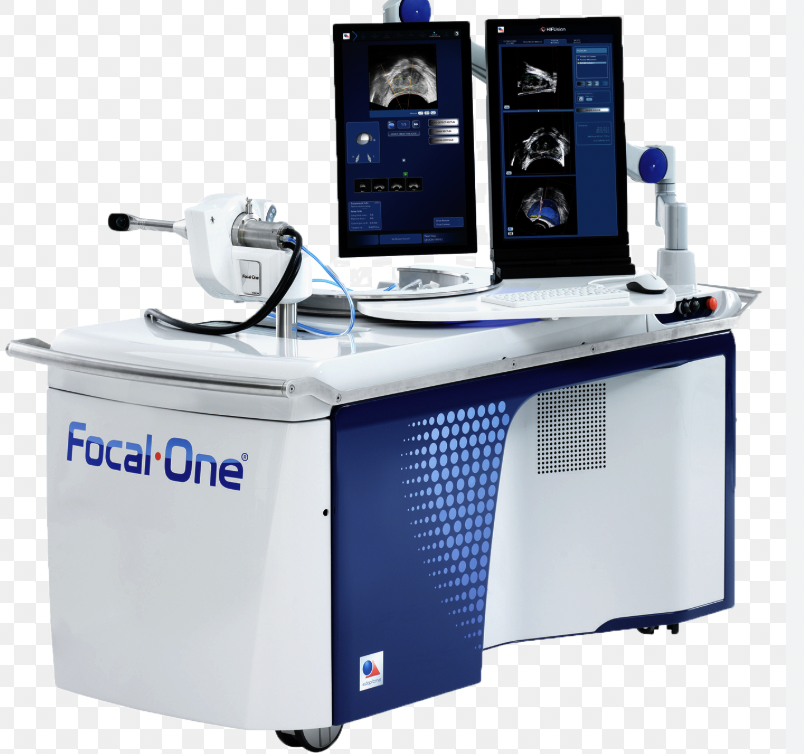

The treatment is delivered under general or spinal anaesthetic in a day-case setting — most men go home the same day. A urinary catheter is typically in place for one to two weeks afterwards while the treated tissue resolves. The whole procedure usually takes one to two hours depending on the volume of prostate tissue being ablated.
What the procedure is and is not
Focal One HIFU is a focal therapy — it does not remove the prostate. The gland stays in place, and only the cancer-bearing zone is ablated. That distinction has important implications for follow-up: PSA remains measurable after treatment because the untreated prostate tissue continues to produce it. This is different from radical prostatectomy, where PSA typically falls to undetectable levels.
It is also not a passive or minor intervention. The ablated tissue is permanently destroyed, and the treatment cannot be "undone." If whole-gland treatment becomes necessary later — because cancer recurs or is found elsewhere in the gland — it will be undertaken in a prostate that has already been partly treated, which can make subsequent surgery more technically demanding.
Who is a genuine candidate
This is where the Focal One HIFU discussion lives or dies. Patient selection is more important here than with almost any other prostate cancer treatment. A targeted treatment is only worthwhile when the disease is actually targetable.
Focal HIFU is aimed at men whose cancer appears genuinely confined to one part of the prostate — typically a single dominant lesion on one side of the gland — and whose biopsy and imaging together give confidence that significant disease is not hiding elsewhere. In practice this usually means:
- Localised prostate cancer — no evidence of spread beyond the prostate capsule
- Low- or intermediate-risk disease by grade (Grade Group 1, 2, or selected Grade Group 3)
- Small tumour volume with a clearly defined index lesion on MRI
- Systematic biopsy of the whole gland confirming no significant contralateral disease
- PSA typically below 15–20 ng/mL and low PSA density
- Prostate anatomy compatible with the transrectal probe approach
Focal therapy cannot safely treat the whole gland — by definition it leaves untreated tissue behind. If clinically significant cancer is present on both sides of the prostate, or in multiple zones, a focal approach will miss disease. Systematic biopsy of the entire gland — not just targeted sampling of the MRI-visible lesion — is essential before Focal One HIFU is offered. MRI-targeted sampling alone is insufficient to exclude bilateral disease.
Even within these broad criteria, not every patient will be suitable. Tumour location within the gland, prior pelvic surgery or radiotherapy, prostate size, urinary symptoms, and the clinical team's confidence in the disease mapping all contribute to the final recommendation. The question is never "Does this patient have localised prostate cancer?" It is "Is this patient's cancer localised enough, and well-mapped enough, for a focal approach to be oncologically appropriate?"
The treatment approach — planning, delivery, recovery
A Focal One HIFU pathway typically involves three distinct stages, each as important as the treatment itself.
Before treatment: the clinical team reviews MRI, biopsy results, and PSA data to map the cancer as accurately as possible. This planning stage defines the ablation zone and confirms that the lesion is suitable for focal treatment. Some men who request focal therapy are advised at this stage that whole-gland treatment or active surveillance would be more appropriate — an honest and clinically necessary conversation.
During treatment: under anaesthetic, the Focal One probe is positioned transrectally and the robotic system delivers the planned ultrasound treatment to the defined prostate zone. The procedure typically takes one to two hours and is performed as a day case.
After treatment: most men go home the same day with a urinary catheter in place for approximately one to two weeks. Mild urinary discomfort and changes in flow are expected while the treated area resolves. Recovery is generally faster than after radical prostatectomy or radiotherapy, and most men return to normal activity within a week or two.

Focal One HIFU compared with surgery, radiotherapy and active surveillance
Focal One HIFU occupies a specific position in the treatment landscape for localised prostate cancer — not a replacement for surgery or radiotherapy, and not the same as active surveillance. Understanding where it sits helps frame the decision conversation honestly.
| Aspect | Focal One HIFU | Whole-gland treatment |
|---|---|---|
| Main target | Selected cancer zone within the prostate | Entire prostate gland |
| Prostate preserved | Yes — untreated tissue remains | No (surgery) or irradiated in full (radiotherapy) |
| Continence risk | Generally lower than whole-gland surgery | Incontinence risk depends on nerve-sparing and technique |
| Erectile function | May be better preserved when cancer is not near NVB | Depends on nerve-sparing; risk of longer-term impact |
| Re-treatment rate | Higher — broadly 20–30% at 5 years across focal modalities | Lower — whole-gland treatment removes the entire cancer target |
| PSA after treatment | Still measurable — produced by untreated tissue | Very low or undetectable (surgery); monitored differently (RT) |
| Follow-up burden | MRI, repeat biopsy — not optional | PSA surveillance; less need for repeat biopsy in early years |
| Long-term evidence | Growing — most follow-up data is 5 years or under | Decades of comparative data for both surgery and radiotherapy |
Considering Focal One HIFU — or want to understand all your options?
Mr Sri offers Focal One HIFU assessment as part of a full prostate cancer treatment planning consultation — alongside surgery, radiotherapy, and active surveillance. Same-week appointments.
What the evidence shows — and its limits
NICE guidance covers focal therapy using HIFU for localised prostate cancer, placing it within a recognised treatment pathway. The NHS describes HIFU as using sound waves to destroy prostate cancer cells. Both describe a treatment that is within mainstream care — not experimental — while consistently framing it as selective rather than universal.
The strongest evidence for focal HIFU is on functional outcomes — particularly urinary continence and erectile function. Compared with whole-gland surgery, focal therapy typically results in less disruption to these functions in the short to medium term, and several systematic reviews report this finding consistently. A 2024 systematic review and meta-analysis reported an overall increase of approximately 3% in pad-requiring urinary incontinence and 11% in new erectile dysfunction after focal therapy — figures generally more favourable than those associated with radical prostatectomy.
The more cautious picture relates to long-term cancer control. Most published follow-up for focal HIFU extends to five to ten years rather than the decades available for surgery and radiotherapy. Re-treatment rates are higher — broadly 20 to 30% at five years across focal modalities. That is not necessarily a reason to avoid focal therapy, but it is an honest part of the conversation, and it requires a patient who genuinely commits to ongoing surveillance.
Follow-up — the non-negotiable part
Because Focal One HIFU leaves part of the prostate in place, monitoring after treatment is as important as the treatment itself. This is not a weakness of the technology — it is how focal therapy is designed to work. The surveillance plan typically includes:
- PSA measurement at 3, 6, and 12 months, then six-monthly
- Multiparametric MRI at 6–12 months to assess the ablated zone and the preserved gland
- Targeted transperineal biopsy at 12–18 months — not optional, not only if symptoms arise
- Further biopsy if PSA rises or MRI shows new suspicious areas in the untreated tissue
Men who find repeat biopsy difficult to accept, or who want certainty above all else, are better served by whole-gland treatment. The commitment to follow-up must be genuine before focal therapy is chosen.
Questions to ask before choosing Focal One HIFU
A productive consultation will move from general interest in the technology to specific answers about your cancer, your imaging, and what follow-up would look like in practice.
- Cancer suitability: Is my prostate cancer localised enough for focal HIFU to make sense — and how confident are you in the disease mapping?
- Systematic biopsy: Has the whole gland been sampled, or only the MRI-visible target — and what did the contralateral side show?
- Treatment intent: Is the aim curative — or controlling the index lesion while accepting that the rest of the gland remains in place?
- Alternatives: How does focal HIFU compare with active surveillance, robotic prostatectomy, and radiotherapy specifically in my case?
- Re-treatment: If cancer recurs in the treated zone or elsewhere in the gland, what options would remain open — and would previous focal treatment complicate them?
- Follow-up plan: What tests are required, and at what intervals — and what would prompt a change in approach?