
What a high RENAL score means for kidney-sparing surgery
A high RENAL score describes a technically complex kidney tumour. It does not mean the cancer is more aggressive, and it does not automatically mean you must lose the whole kidney.

In this article
When a scan report mentions a high RENAL score, it can sound as though the door has closed on kidney-sparing surgery. In practice, that is not what the score is designed to say.
A high score points to anatomical complexity. It tells the surgical team that the tumour may be deeper, closer to the kidney's drainage system, nearer major blood vessels, or in a position that makes repairing the kidney harder once the tumour is out. It does not describe the stage of the cancer, and it does not automatically mean the whole kidney must be removed.
That distinction matters, especially in complex partial nephrectomy, where the aim is to remove the tumour while keeping as much healthy kidney as possible.
What the RENAL nephrometry score measures
The RENAL nephrometry score is a structured way of describing the anatomy of a kidney tumour on CT or MRI. Instead of a vague phrase such as "a difficult tumour", it breaks the scan findings into features that can be discussed clearly when planning treatment.
The name comes from the five features it assesses: the tumour's Radius, whether it is Exophytic (growing outwards) or endophytic (buried within the kidney), its Nearness to the collecting system or renal sinus, whether it sits on the Anterior or posterior surface, and its Location relative to the kidney's polar lines.
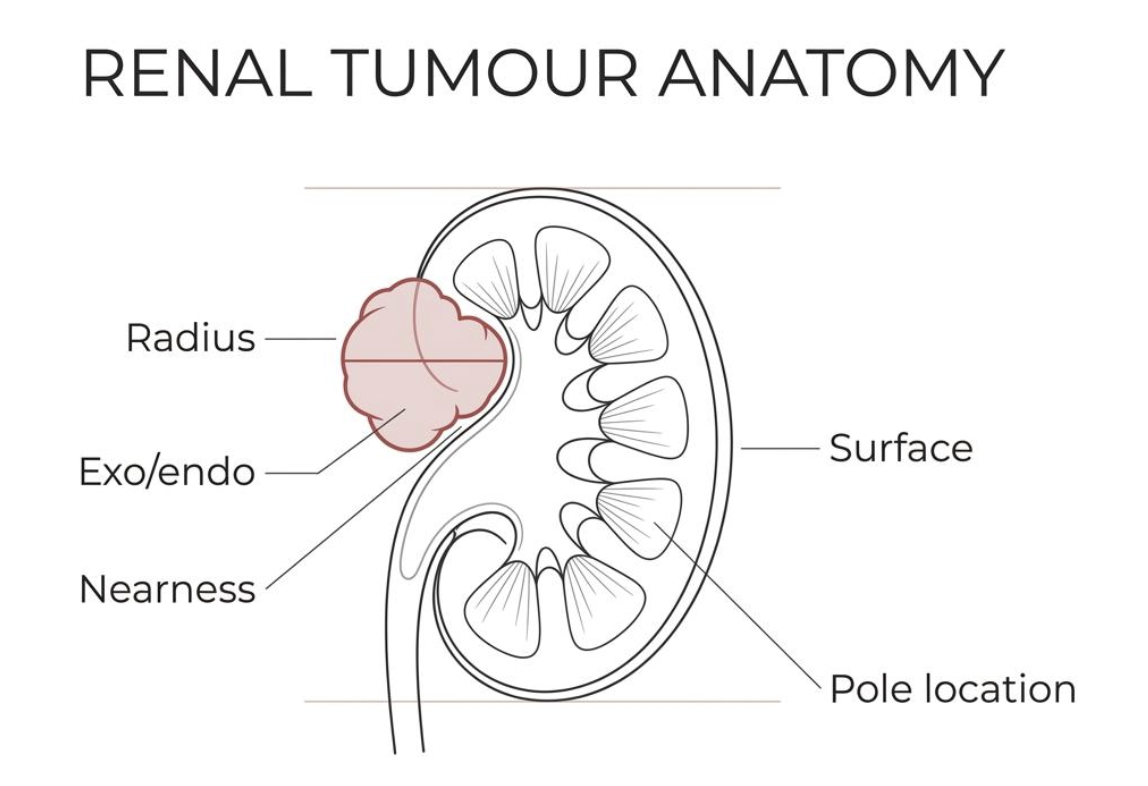
A useful way to think about it: the score is about the shape and position of the tumour, not whether the cancer is aggressive.
| RENAL element | What it describes | Why it matters for partial nephrectomy |
|---|---|---|
| RRadius | Tumour size on imaging | Larger tumours usually leave less room for easy removal |
| EExophytic or endophytic | How much the tumour projects out of, or sits within, the kidney | Deep, endophytic tumours are harder to see and remove cleanly |
| NNearness | Distance to the collecting system or renal sinus | Close proximity makes entry into the drainage system and complex repair more likely |
| AAnterior or posterior | Which surface of the kidney the tumour faces | Helps plan the surgical approach. Back-facing tumours are often well suited to robotic surgery from behind |
| LLocation | Whether the tumour sits towards the upper pole, lower pole or central region | Central and hilar positions usually increase technical difficulty |
Each feature is scored, and the total falls into one of three bands:
What a high RENAL score means for complex partial nephrectomy
A high RENAL score usually means the tumour is not simply sitting on the outer edge of the kidney. It may be buried within the kidney, close to the hilum where the main vessels enter, near the collecting system, or crossing central landmarks. Each of these features makes removing the tumour and repairing the kidney more demanding.
This is why a high score is so often linked with the phrase complex partial nephrectomy. The operation may still be very reasonable, but it needs more detailed planning, greater technical control and a sharper focus on preserving blood supply and function.
Features that commonly push the score up include:
- larger tumour size
- more endophytic (buried) growth
- closeness to the collecting system
- a central or hilar location
- a position crossing the polar lines
Why high complexity makes kidney-sparing surgery harder
During partial nephrectomy, the surgeon must remove the tumour completely, control bleeding, keep as much healthy kidney as possible, and repair the kidney afterwards. When the anatomy is straightforward, those aims are easier to balance. When the RENAL score is high, each step becomes tighter and less forgiving.
A deep or central tumour may not be visible on the kidney's surface. A tumour near the renal sinus can sit close to major vessels and the drainage system. If the collecting system is opened during removal, the repair is more intricate. And if the blood supply needs to be clamped, keeping that time short, known as the warm ischaemia time, becomes more important for protecting kidney function.
The key technical pressures are:
- Exposure: safely reaching a tumour that is not visible on the surface
- Margins: removing the tumour completely while sparing normal kidney
- Bleeding control: the kidney is one of the body's most blood-rich organs
- Collecting system repair: closing any opening into the urine drainage system
- Reconstruction: restoring the kidney's shape and sealing the cut surface
These are exactly the situations where experience, careful review of the imaging and a well-rehearsed operative plan matter most.
Why a high RENAL score does not rule out kidney preservation
Guidelines support partial nephrectomy for T1 kidney tumours, and for selected T2 tumours where keeping kidney tissue is especially valuable and the operation is technically feasible. That matters even more for someone with a single kidney, chronic kidney disease, or damage to the other kidney.
The reason is simple. For localised kidney cancer, partial nephrectomy preserves kidney function better than radical nephrectomy, where the whole kidney is removed, and that benefit can shape your kidney health for decades. I explain this further in can a kidney tumour be removed without losing the whole kidney?
So the real question is not "is the RENAL score high?" but "can a safe and effective partial nephrectomy be performed in this patient, for this tumour, by this team?"
Complex tumours in my practice
I accept referrals for kidney tumours that other centres have judged too complex for kidney-sparing surgery. From my audited robotic series:
Audited robotic series to the end of 2025. Trifecta: clear margins, no major complications and warm ischaemia under 25 minutes. See all outcomes
How surgeons decide between partial and radical nephrectomy
The RENAL score is one part of the decision, not the whole of it. A treatment plan brings together the imaging, tumour size, cancer control, kidney function and your wider health.
Someone with a high-complexity tumour and strong reasons to protect kidney function may still be an excellent candidate for complex partial nephrectomy. Someone else, with limited surgical fitness, unfavourable anatomy and a healthy opposite kidney, may be better served by radical nephrectomy. Both decisions can be sensible.
Points that usually shape the decision:
- Baseline kidney function: whether there is already chronic kidney disease
- The other kidney: whether it is healthy, damaged or absent
- Tumour anatomy: how close the tumour is to the vessels, sinus and collecting system
- Cancer control: whether kidney-sparing surgery can still remove the cancer reliably
- Surgical fitness: how well you would tolerate a longer, more intricate operation
- Team expertise: experience with high-complexity partial nephrectomy
For some larger, higher-risk tumours, the best choice is still being tested. I am Principal Investigator at St George's for the national PARTIAL trial, which compares robotic partial nephrectomy with removal of the whole kidney in exactly this group of patients.
Why imaging and planning matter for high-score tumours
For complex partial nephrectomy, reviewing the imaging is not a formality. It is the map. High-quality CT or MRI shows how much of the tumour is buried, how close it lies to the collecting system, whether the renal sinus is involved and where it sits relative to the polar lines.
That detail shapes the operation in practical ways: how you are positioned, which approach is used, the likely line of removal, whether the blood supply needs clamping, and how the kidney will be rebuilt afterwards. Better planning tools are an active area of research. I was Principal Investigator for VISP, a trial of 3D patient-specific kidney models for planning robotic partial nephrectomy.
Robotic partial nephrectomy has widened what can be attempted with precision, especially for complex tumours. For tumours on the back of the kidney, I usually operate from behind, without entering the abdominal cavity, an approach I explain in retroperitoneal robotic partial nephrectomy. But the robot does not remove complexity on its own. Good results still depend on judgement, planning and the ability to adapt when the anatomy in theatre differs from the scan.
A high RENAL score should prompt better planning, not resignation.
Questions to ask when your RENAL score is high
When complexity is mentioned, it is reasonable to ask exactly what it means for the operation being proposed. Clear questions lead to clearer decisions, and they move the conversation from a single number to the bigger picture: cancer control, kidney preservation and safety.
- What features on my scan make the tumour high complexity?
- Is partial nephrectomy still technically possible in my case?
- What are the main risks of kidney-sparing surgery for this tumour?
- How much would preserving the kidney benefit my long-term kidney function?
- If you recommend removing the whole kidney, what makes that the safer option for me?
- How many complex partial nephrectomies does your team perform?
How to read a high RENAL score without assuming the worst
A high RENAL score is a sign of surgical challenge, not a statement that kidney-sparing treatment has failed before it begins. It says the tumour's anatomy deserves close scrutiny and a skilled plan. It does not say the whole kidney must be sacrificed.
The score defines complexity on imaging. The treatment choice still rests on feasibility, safety, cancer control and the value of keeping kidney function wherever possible. If you would like an expert view on your scans, you can book a consultation or, if you are a clinician, refer a patient.
