
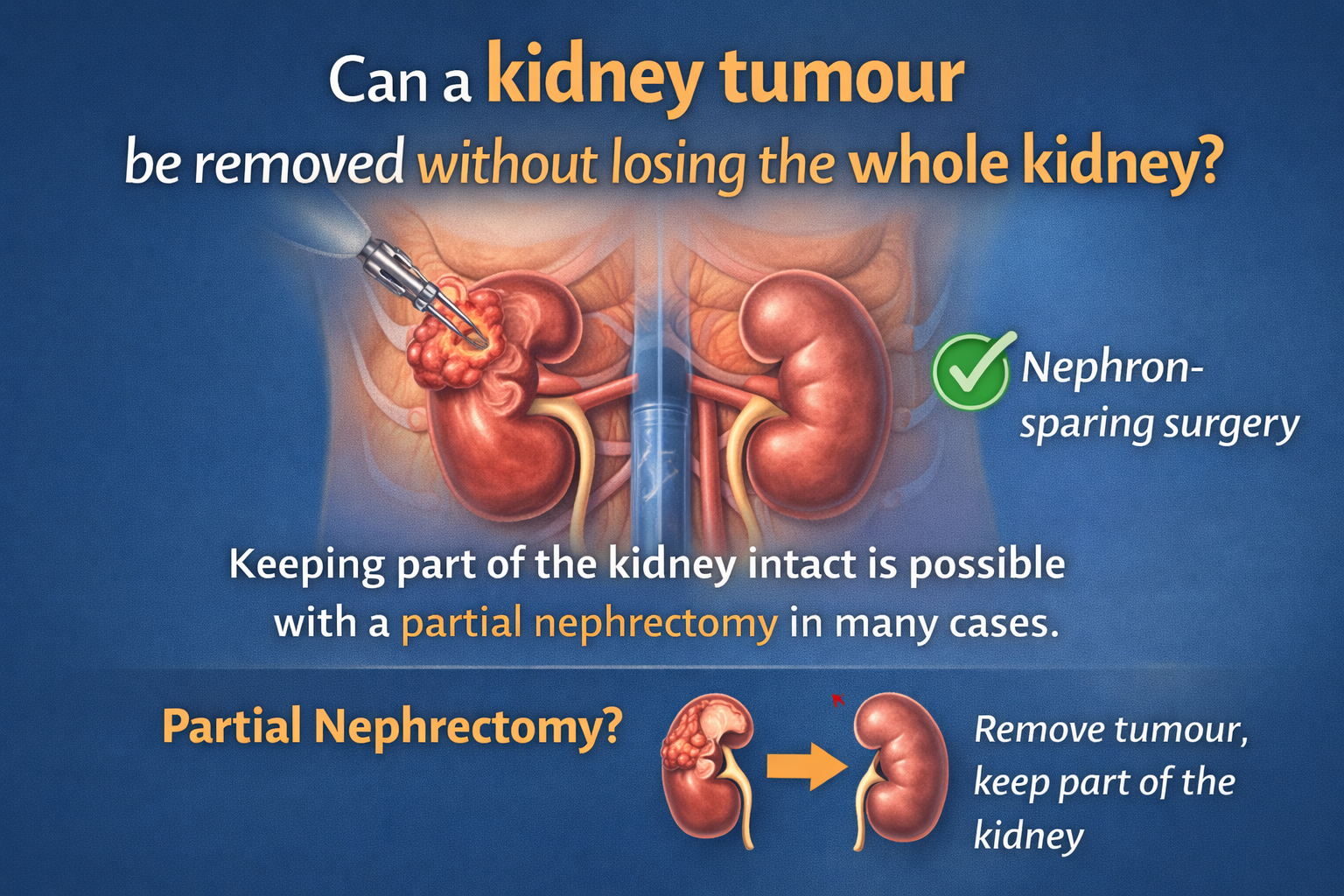
Many people still assume that a kidney tumour means losing the whole kidney. That was often true in the past. It is no longer the default.
For a large number of localised kidney tumours, surgeons can remove the tumour itself and leave the rest of the kidney in place. This is called partial nephrectomy, and when it is carried out with robotic assistance it has become one of the most important advances in modern kidney cancer surgery.
A kidney tumour does not automatically mean losing the whole kidney. For many patients — including those with complex or high-risk tumours — kidney-preserving robotic surgery achieves equivalent cancer control while protecting long-term kidney function. A specialist opinion is essential before accepting that radical nephrectomy is the only option.
Robotic retroperitoneal partial nephrectomy explained — what the operation involves, why the approach matters, and what recovery looks like.
Full procedure guide →Kidney-sparing surgery for localised kidney tumours
The core idea is straightforward. If the cancer is confined to one part of the kidney and the rest of the organ is healthy, there may be no need to remove the entire kidney. A partial nephrectomy aims to excise the tumour with a clear margin while preserving as much normal kidney tissue as possible.
Current urology guidelines strongly support this kidney-sparing approach for many small renal masses — especially tumours up to 4 cm and a good number up to 7 cm when the anatomy is favourable. Cancer control is often comparable to removing the whole kidney, while long-term kidney function is usually better preserved.
That matters more than many patients initially realise. Kidney tissue is not spare capacity. Preserving nephrons can reduce the risk of chronic kidney disease, future cardiovascular strain, and the cumulative effect of age, diabetes, hypertension, or other conditions that affect renal function over time.
How robotic partial nephrectomy is performed
Robotic partial nephrectomy is not a robot acting alone — the surgeon remains in full control throughout, using a console that directs highly articulated instruments and a magnified three-dimensional camera view. This gives the surgical team a degree of precision that is particularly valuable during the most delicate parts of the procedure: identifying the tumour plane, controlling blood vessels, protecting the collecting system, and reconstructing the kidney afterwards.
Before surgery, imaging is studied in detail — usually with contrast CT or MRI. This shows tumour size, depth, relationship to blood vessels, and proximity to the urinary collecting system. Some centres also use three-dimensional reconstructions to plan the operation more precisely.
The operation proceeds through a consistent sequence:
The retroperitoneal advantage
Most surgeons approach the kidney through the abdomen. Mr Sri approaches from behind — through the retroperitoneal space — without entering the abdominal cavity at all. This eliminates bowel handling, results in faster gut recovery, less post-operative bloating, and a smoother path home. For posterior and upper-pole tumours it also provides the most direct operative route.
He is one of a small group of surgeons in Europe to use this as their default approach, and has published its long-term outcomes in the Journal of Robotic Surgery. He accepts tertiary referrals for tumours declined elsewhere for kidney-preserving surgery — 48% of his cases fall in the highest complexity category.
Told a kidney tumour needs the whole kidney removed?
Mr Sri accepts second opinion referrals for complex kidney tumours, including cases declined elsewhere for kidney-preserving surgery. Same-week appointments available.
Who is suitable for robotic partial nephrectomy?
Not every kidney tumour can be managed this way, and not every patient benefits from the same plan. The decision rests on tumour features, baseline kidney health, and surgical complexity.
Small, peripheral, exophytic tumours — those sitting towards the outer surface of the kidney — are often ideal. Tumours closer to the centre of the kidney, near major vessels or the collecting system, can still sometimes be managed with robotic partial nephrectomy, though the surgery becomes more technically demanding. Anatomical scoring systems help surgeons judge complexity and estimate whether a kidney-sparing approach is sensible and safe for a given patient.
Patient factors can be decisive. Someone with one kidney, reduced kidney function, diabetes, high blood pressure, or bilateral tumours has a particularly strong reason to preserve renal tissue where this can be done safely — and this is precisely when a specialist second opinion matters most.
Comparing the treatment options
| Treatment approach | Often best suited to | Main advantage | Main limitation |
|---|---|---|---|
| Robotic partial nephrectomy | Localised tumours where kidney preservation is feasible | Preserves kidney function with minimally invasive surgery | Technically complex in central or very large tumours |
| Radical nephrectomy | Very large, invasive, or anatomically unsuitable tumours | Simpler cancer removal in selected cases | Loss of an entire kidney |
| Cryoablation / RFA | Small tumours in patients unfit for surgery | Least invasive option, easier recovery | Higher local recurrence risk than surgery, especially in larger tumours |
| Active surveillance | Small masses in selected older or frailer patients | Avoids immediate treatment | Requires ongoing imaging follow-up; risk of growth and delayed intervention |
Benefits and trade-offs
The most obvious benefit of robotic partial nephrectomy is kidney preservation. Keeping more renal reserve is valuable even when the opposite kidney appears healthy — because that opposite kidney also ages, and may later be affected by the same conditions that compromise kidney function in the general population.
A second benefit is the minimally invasive approach itself. Compared with open surgery, robotic operations typically mean smaller incisions, less blood loss, shorter hospital stay, and faster return to ordinary activity. Many patients are surprised by how quickly they are walking after surgery.
This is not, however, simple surgery. Partial nephrectomy is more intricate than removing the whole kidney. The surgeon must balance cancer clearance with tissue preservation, all while managing bleeding risk and protecting kidney function. Complications can include bleeding, urine leakage, or — less commonly — the need to convert to a radical nephrectomy if the anatomy proves unsafe during the procedure.
Partial nephrectomy offers the strongest balance of cancer control and kidney preservation for many fit patients. Ablation reduces the immediate treatment burden but offers lower certainty of local control. Surveillance avoids treatment now, accepting ongoing monitoring and possible delayed intervention. Radical nephrectomy remains the right choice when anatomy or tumour biology makes kidney-sparing surgery unsuitable — but the threshold for that decision is higher than it used to be.
Recovery after robotic kidney tumour surgery
Recovery usually begins quickly. Most patients are encouraged to mobilise on the day of surgery or the morning after. Hospital stay is often one to two nights, though that varies with tumour complexity and general health.
A urinary catheter is commonly used for a short period. Blood tests assess kidney function and haemoglobin. If a drain is placed, it is removed once output is low and there is no sign of a urine leak. At home, energy tends to return over days to weeks rather than all at once. Heavy lifting is restricted for a period, and follow-up imaging is arranged to confirm healing and monitor for recurrence.
Questions that shape the decision
The right treatment plan usually comes from asking the right questions rather than accepting a one-size-fits-all rule. At consultation, the conversation typically covers:
- Tumour anatomy: is it peripheral, central, endophytic, or hilar — and what does the scoring suggest about complexity?
- Kidney function: how strong is the affected kidney now, and what is the likely long-term impact of losing it?
- Surgical feasibility: can a partial nephrectomy be done safely, including the likely warm ischaemia time?
- Cancer behaviour: does imaging suggest an aggressive lesion that changes the balance of the decision?
- Personal priorities: kidney preservation, recovery speed, and procedural risk all weigh differently for different patients
For many patients, the answer to the original worry is reassuring. A kidney tumour does not automatically mean losing the whole kidney. With careful imaging, experienced surgical planning, and the precision of robotic partial nephrectomy — especially via the retroperitoneal approach — kidney-sparing treatment is often not only possible but preferred.