
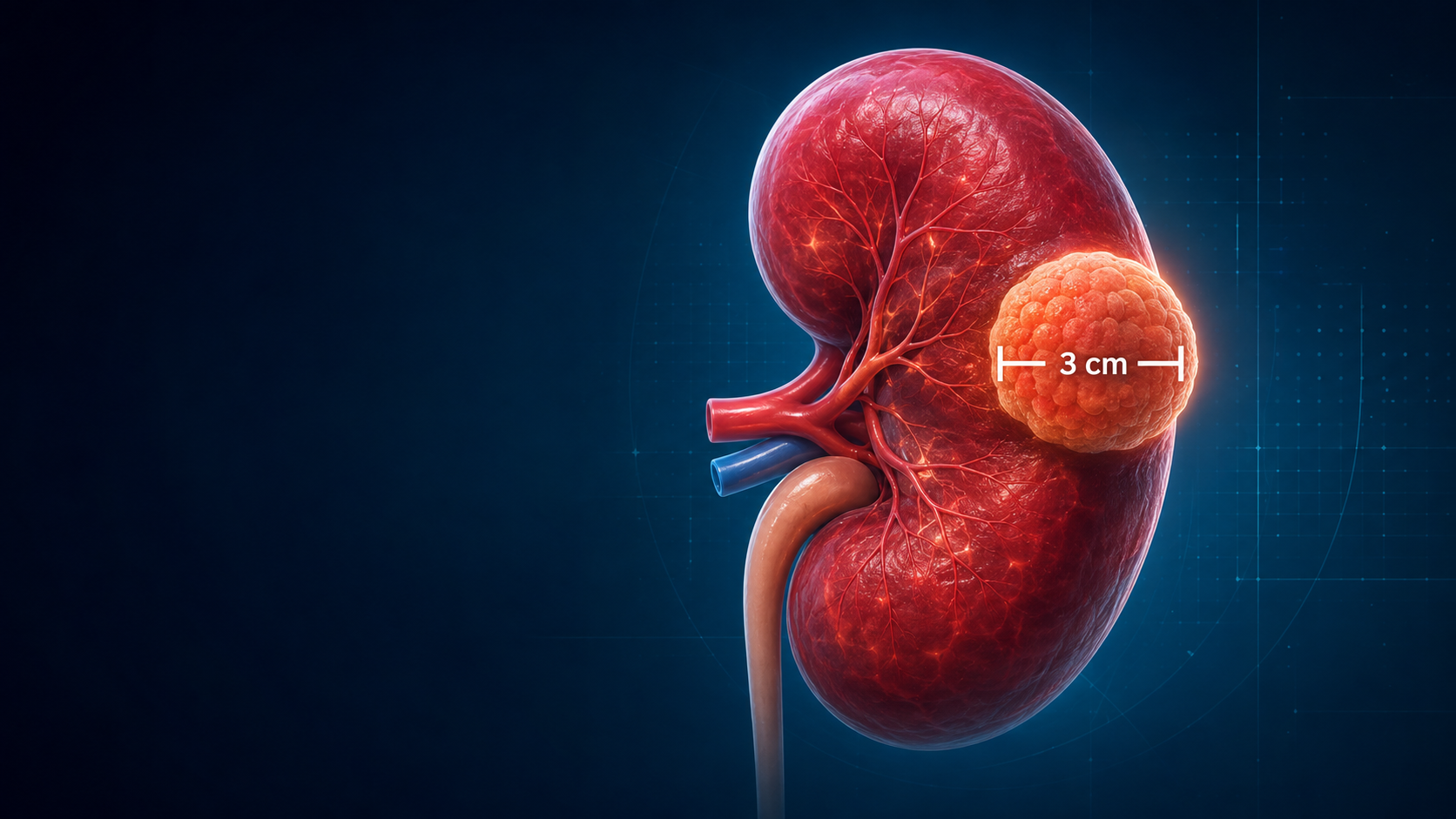
What is the best treatment for a 3cm kidney tumour?
A 3cm kidney tumour sits in an important clinical zone — small enough that kidney-sparing treatment is usually achievable, large enough that active treatment is almost always the right call for a fit person. This article explains every option, how tumour location changes the surgical picture, and when complex kidney-sparing robotic surgery can make the difference between losing a kidney and keeping it.
A 3cm kidney tumour sits in an important middle ground. It is small enough that kidney-sparing treatment is often possible, yet large enough that simple observation is not usually the right first choice for a fit person who could have curative treatment.
For most people with a localised 3cm kidney tumour, the treatment most often regarded as best is partial nephrectomy — removing the tumour while keeping as much healthy kidney tissue as possible. Current NICE guidance places surgery at the centre of treatment for solid kidney masses 2cm or larger when surgery is suitable, and gives preference to partial nephrectomy when the tumour can be completely removed safely.
A 3cm kidney tumour is not a single clinical scenario. Two people with the same measurement on their scan report can face very different surgical challenges depending on where the tumour sits within the kidney. That is why tumour position — not just size — shapes everything that follows.
Why a 3cm tumour matters clinically
A 3cm tumour is usually classed as a small renal mass. In many cases it is still confined to the kidney, which creates a strong chance of effective local treatment aimed at cure rather than long-term disease control. That is an encouraging starting point.
Size is only one part of the picture. Doctors also consider where the tumour sits within the kidney, how easy it is to reach surgically, how well both kidneys are working, and whether the person is fit for an operation. A 3cm tumour on the outer edge of the kidney is very different from a 3cm tumour tucked close to major blood vessels or the renal collecting system.
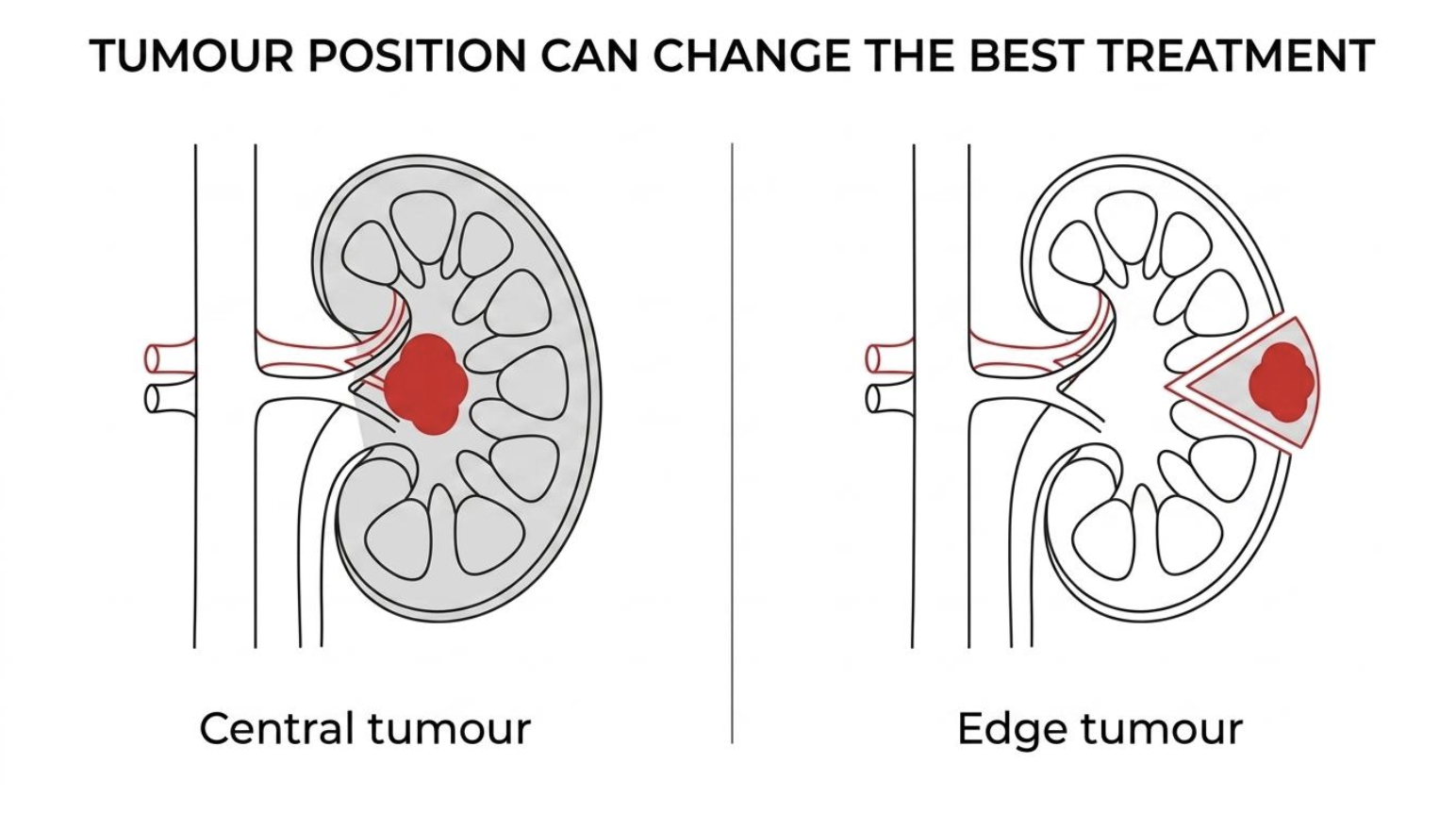
This is why two people with the same tumour size may be advised to have different treatments, even when their scan reports sound similar. The RENAL nephrometry score — a standardised system grading tumour complexity based on radius, exophytic proportion, collecting system proximity, and other anatomical features — gives surgeons a shared language for this. At my practice, 48% of cases fall in the highest complexity category by RENAL score, including many tumours that have been declined for kidney-sparing surgery elsewhere.
Partial nephrectomy — the leading option for most fit patients
For a localised 3cm kidney tumour in a fit patient, partial nephrectomy is generally the first-choice treatment when technically feasible. NICE states that surgery is the preferred option for solid renal masses 2cm or larger when surgery is suitable. When the choice is between removing part of the kidney and the whole organ, NICE gives preference to partial nephrectomy if the tumour can be completely excised with preservation of the remaining tissue.
That preference reflects two goals at once: treating the cancer with curative intent, and protecting long-term kidney function. Keeping healthy kidney tissue matters — particularly for people who already have reduced kidney function, diabetes, high blood pressure, or a higher risk of kidney disease in later life. Losing an entire kidney unnecessarily can accelerate that trajectory meaningfully over a decade or more.
In practical terms, partial nephrectomy aims to remove the tumour with an adequate margin of safety while leaving the rest of the kidney intact and functional. It can be performed through open, laparoscopic, or robotic techniques. Robotic-assisted partial nephrectomy (RAPN) is now widely used for small renal masses and offers the precision, magnification, and dexterity that complex cases often demand.
Most robotic partial nephrectomies are performed transperitoneally — entering through the abdomen. My default approach is retroperitoneal: reaching the kidney directly from behind through the flank, without entering the peritoneal cavity.
This provides more direct access to posterior and lateral tumours — precisely the location where many 3cm tumours sit — reduces the risk of intraperitoneal complications, and is associated with faster return of bowel function and a shorter hospital stay. It also means previous abdominal surgery is less of a limiting factor. The published evidence from my series demonstrates this approach is safe and effective even for the most complex tumours.
For most patients with a 3cm posterior or lateral kidney tumour, the retroperitoneal robotic approach offers technical advantages that the transabdominal route cannot match.
These outcomes are from my own audited surgical series, published in the Journal of Robotic Surgery (2023), using the retroperitoneal robotic approach as my default technique for partial nephrectomy.
Robotic partial nephrectomy — full procedure guide →When radical nephrectomy is chosen instead
Sometimes partial nephrectomy is not the safest or most reliable operation. If the tumour's position makes kidney-sparing surgery technically too risky, or if complete excision cannot be achieved with sufficient confidence, radical nephrectomy — removing the whole kidney — may be the correct recommendation.
This does not mean the cancer is more advanced. A small tumour can be deeply embedded, closely abutting the renal hilum, or in a position where the risk of warm ischaemia time or vascular injury makes partial removal unsafe in less experienced hands. The key point is this: for a 3cm tumour, radical nephrectomy is usually the backup surgical plan, not the first preference, when partial nephrectomy is technically feasible — and what is "feasible" is partly a function of who is doing the operation.
Mr Sri accepts second opinion referrals for complex kidney tumours, including cases declined elsewhere for partial nephrectomy. Same-week appointments at four London locations.
Active surveillance for selected 3cm tumours
Active surveillance means keeping the tumour under close review with regular scans and clinic appointments rather than treating it immediately. NICE advises that surveillance can be considered for localised small renal masses when surgery is not needed, possible, or suitable. European guidance reserves this approach mainly for frail patients or those with significant competing illnesses.
At 3cm, the tumour is large enough that most specialists would lean towards treatment if the person can tolerate surgery well. Active surveillance is medically sound when driven by overall health and risk profile — but it should be an explicit, considered decision, not a default because the operation seemed technically difficult.
Serious heart or lung disease, limited life expectancy, or high anaesthetic risk can make the risks of surgery outweigh its benefits — in which case surveillance is entirely reasonable. What should not drive the surveillance decision is a surgeon's unfamiliarity with complex kidney-sparing technique. If you have been offered surveillance for a 3cm tumour and you are otherwise fit, it is worth asking whether a second opinion with a specialist in complex partial nephrectomy would change the conversation.
Thermal ablation for a 3cm kidney tumour
Thermal ablation — cryoablation or radiofrequency ablation — destroys tumour tissue using extreme cold or heat delivered via percutaneous needles. NICE advises that ablation may be considered for localised small renal masses when surgery is not needed, possible, or suitable, and makes clear that ablation should not be offered without prior biopsy confirmation of malignancy. European guidance advises against routinely offering thermal ablation for tumours larger than 3cm.
At exactly 3cm, ablation may still be considered in selected patients — particularly those who are not fit for surgery. But it is not the standard leading option for a patient who can safely undergo partial nephrectomy, and its re-treatment rate and reliance on post-treatment imaging for confirmation are important practical considerations.
All treatment options at a glance
| Treatment | Role for a localised 3cm tumour | Main advantage | Main limitation |
|---|---|---|---|
| Partial nephrectomy | First choice when technically feasible — NICE preferred option | Removes tumour with curative intent; preserves kidney tissue | Requires surgery; complexity varies by tumour location |
| Retroperitoneal robotic RAPN | Preferred approach for posterior/lateral and complex tumours | Direct kidney access without entering abdomen; enables complex kidney-sparing surgery | Requires surgeon trained in the retroperitoneal robotic technique |
| Radical nephrectomy | When partial nephrectomy is not safe or achievable | Reliable complete removal of the kidney and tumour | Loss of the entire kidney — long-term functional consequences |
| Active surveillance | Frailty, major comorbidity, or high anaesthetic risk | Avoids immediate treatment; appropriate for selected patients | Ongoing monitoring without removal; not standard for fit patients at 3cm |
| Thermal ablation | Selected patients unsuitable for surgery, after biopsy | Less invasive; day case or short stay | Not routinely offered beyond 3cm; requires biopsy; follow-up imaging essential |
How the decision is actually made
Questions to ask at your consultation
- Am I a good candidate for partial nephrectomy — and if not, exactly what makes kidney-sparing surgery difficult in my case?
- What is the RENAL complexity score for my tumour, and what does that mean for surgical difficulty and technique?
- Would the retroperitoneal or transperitoneal robotic approach be used for my tumour — and why?
- Has my case been discussed at a multidisciplinary team meeting?
- Is biopsy needed before any treatment, and what does the answer depend on?
- If surveillance is being suggested, is that because treatment is genuinely disproportionate — or because the operation would be technically challenging?
- How might this treatment affect my kidney function over the next ten years?
- If I want a second opinion before deciding, can you support that?
Mr Denosshan Sri — MA Cantab · MB BChir · FRCS (Urol)
Consultant Urological Surgeon and Kidney Cancer Lead for South West London. Mr Sri's robotic kidney surgery series includes over 900 cases with a published 97% trifecta rate and 0% open conversion, using the retroperitoneal approach as his default technique. 48% of his cases fall in the highest RENAL complexity band. He accepts second opinion referrals for complex and high-score tumours, including cases declined elsewhere for kidney-sparing surgery. Full profile and publications →
Kidney tumour — want expert assessment or a second opinion?
Mr Sri accepts referrals for kidney tumours at all complexity levels, including cases declined elsewhere for kidney-sparing surgery. Retroperitoneal robotic partial nephrectomy is his default approach. Same-week appointments at four London locations. No GP referral required.