
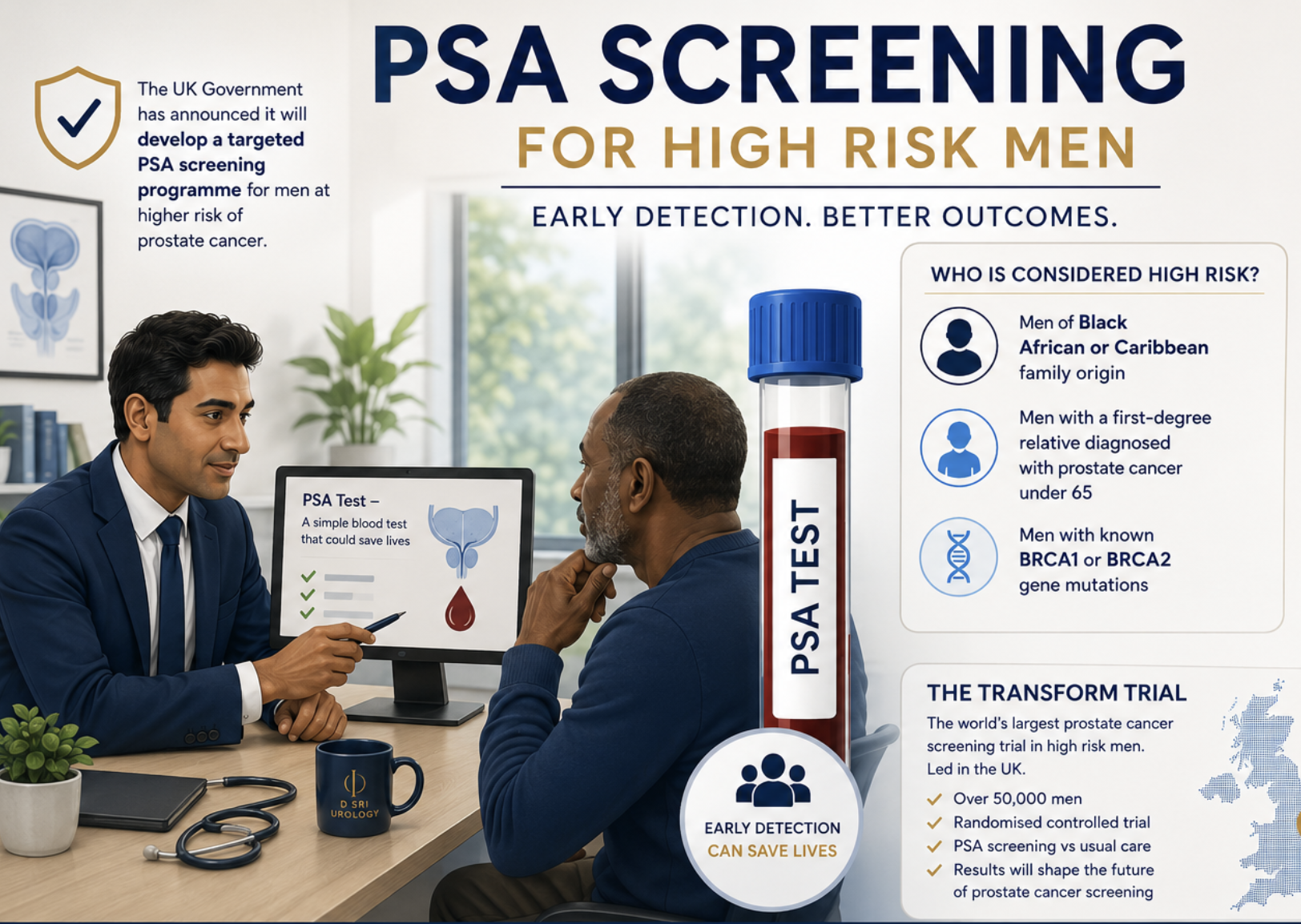
PSA Screening for High-Risk Men in the UK: What the New Recommendations Mean
In June 2026, the UK government accepted the first targeted prostate cancer screening recommendation in England's history. It is real progress — and it is narrower than many men will assume from the headlines. Here is what the change actually means, who is still excluded, and what high-risk men should do right now.
PSA screening has shifted in a way the UK has never seen before. In June 2026, the UK government accepted the UK National Screening Committee’s recommendation to introduce England’s first targeted prostate cancer screening programme, for men aged 45–61 with a pathogenic BRCA2 variant and relevant family history. Rollout is expected from 2027. That is a genuine landmark — the first time any form of prostate cancer screening has been formally recommended in this country.
It is also narrower than many men may assume from the headlines.
From the perspective of the clinicians who see men after a screening result, this matters because screening is only the first step. A blood test may reassure, prompt monitoring, lead to scans and biopsy, or identify a cancer that needs treatment. So the real question is not only who is being invited. It is also who is still outside the formal offer — and what they should do now.
A new targeted prostate cancer screening programme now exists in England — but it applies to a tightly defined group. Most men at elevated risk are still not covered by a routine NHS invitation. Knowing where you stand is the first step to acting appropriately.
What the new UK prostate cancer screening decision means
For the first time, there is a recommended prostate cancer screening programme of any kind in England. The offer is targeted, not population-wide. It is aimed at men aged 45 to 61 who have a confirmed pathogenic BRCA2 variant and a family history of breast, ovarian, pancreatic, or prostate cancer. For this group, the recommendation is PSA testing every two years.
That change is significant because the UK NSC has repeatedly judged that routine PSA screening for the general population would cause too much harm relative to benefit. The concern is not the blood test itself — it is overdiagnosis, unnecessary biopsy, anxiety, and treatment for cancers that may never have caused trouble. In the BRCA2 group with the relevant family history, the evidence now suggests the balance looks different. Repeated screening is judged more likely to do more good than harm.
- ✅ Men aged 45–61 with a confirmed pathogenic BRCA2 variant and relevant family history → biennial PSA screening recommended
- ❌ Black men without a pathogenic BRCA2 variant → no national targeted programme yet (can still request GP test)
- ❌ Men with a strong family history of prostate cancer alone → not included in the new programme
- ❌ General population → PSA testing remains available by request, not routine invitation
| Group | Current screening position | What to do |
|---|---|---|
| Men aged 45–61 with pathogenic BRCA2 variant and relevant family history | Targeted biennial PSA screening now recommended | Respond when invited. Keep to the two-yearly interval. |
| Black men without a pathogenic BRCA2 variant | No national targeted programme — can request GP test | Ask your GP for a PSA test now if over 45. Do not wait. |
| Men with strong family history of prostate cancer (no BRCA2) | No national programme — discuss risk with GP | Raise family history clearly with your GP or a specialist. |
| General male population | No population screening programme | PSA testing available on request. Discuss pros and cons with GP first. |
Why Black men in the UK should not wait for a national programme
This is where the current policy feels genuinely incomplete. Black men face a substantially higher burden of prostate cancer, yet they are not included in the new national targeted screening offer unless they also carry a BRCA2 variant.
That matters in clinic. Men do not present as policy categories. They present as individuals with a real level of risk, a family, and a need for clarity. When a group has a markedly higher incidence and worse mortality, waiting for a perfect national scheme is not a good personal strategy.
Do not wait for a national programme. Ask your GP for a PSA test even if you feel entirely well. Prostate Cancer UK advises this now, and the advice is clinically sound. If your GP declines, you can request a private PSA assessment — the test is simple, a single blood draw, and results are typically available within days.
The TRANSFORM trial — the most hopeful development for equity
Beyond the BRCA2 decision, the most significant development for underserved groups is the role of the TRANSFORM trial. This study matters because it is designed to answer the questions that older screening research could not resolve clearly enough — in particular, how screening affects benefit and harm in Black men specifically.
One of the persistent problems in prostate cancer screening evidence has been representation. Previous major trials did not include enough Black men to show clearly, and with sufficient statistical confidence, how screening affects this group. When the data are thin, policy becomes cautious. That caution may be understandable at a population level, but it leaves a serious gap at the individual level.
In June 2026, extra government investment of up to £18 million was announced to support the next phase of TRANSFORM. From stage 2 onwards, all eligible Black men aged 45 to 74 who have not had a recent PSA blood test will be invited to participate. That is a meaningful commitment — it moves from general acknowledgement of inequality to active recruitment at scale.
Receiving an invitation to TRANSFORM means being offered a PSA blood test as part of a structured research pathway. It is not a replacement for ordinary NHS care — it is a route to stronger evidence and, over time, fairer policy. If you are a Black man aged 45 to 74, watch for an invitation.
But TRANSFORM is not a reason to wait passively. You can ask for a PSA test now through your GP or through a private specialist — the two approaches are not mutually exclusive.
What happens after a raised PSA result
A raised PSA does not mean an automatic cancer diagnosis — and it certainly does not mean instant treatment. It means the assessment pathway begins. Understanding what that pathway looks like reduces unnecessary anxiety and helps men engage with it appropriately.

Before anything else — PSA can rise for reasons that have nothing to do with cancer. Benign prostate enlargement, prostatitis, urinary infection, recent ejaculation, vigorous cycling, catheter use, or recent urological procedures can all push the number up. This is why context matters far more than the number alone.
Mr Sri offers expert PSA assessment including clinical review, mpMRI, and targeted transperineal biopsy where indicated. Same-week appointments. No GP referral required.
What high-risk men should do now — a clear summary
If you are in the newly included BRCA2 group, respond when invited and keep to the recommended two-yearly testing interval. That is now the formal NHS recommendation for your situation.
If you are a Black man aged 45 or over, ask your GP for a PSA test even if you feel entirely well. Prostate Cancer UK currently advises this, the evidence supports it, and no national programme is coming soon enough to make waiting a sensible personal strategy. If a national screening letter has not arrived, it almost certainly will not — because you are not yet in a formally invited group. Act now.
If you have a strong family history of prostate, breast, ovarian or pancreatic cancer in a first-degree relative, raise that history clearly in any GP or specialist consultation. Family history alone does not currently qualify you for the new national programme, but it meaningfully changes the risk conversation — and a specialist can advise on whether earlier or more frequent testing makes sense for your individual situation.
If you are not in any of these groups but are a man in your 50s or 60s curious about your prostate health, PSA testing is available by request. The test is not perfect, and the discussion beforehand about what a raised result would mean — and what the follow-up pathway involves — is genuinely important. Going in informed is far better than going in blind.
- BRCA2 group (45–61, pathogenic variant, family history) — await your NHS invitation, respond promptly
- Black men aged 45+ — request a PSA test from your GP or book a private assessment now
- Men with family history of relevant cancers — discuss with GP or specialist; document the history clearly
- All men with a raised PSA — begin the structured assessment pathway; a raised PSA is a flag, not a verdict
- All men considering PSA testing — read the raised PSA assessment page and the articles on PSA 5, PSA 3, and PSA 10 to understand what your result may mean