Robotic Prostatectomy Surrey | Prostate Cancer Surgeon South West London — dsri.co.uk
Robotic Prostatectomy · Surrey & South West London · Cheam · Wimbledon

Robotic-Assisted Radical Prostatectomy in Surrey

Nerve-sparing prostate cancer surgery performed at Spire St Anthony's Hospital, Cheam and Nuffield Health Parkside, Wimbledon — serving patients across Surrey and South West London.

Mr Sri holds his Surrey practice across two accessible South West London locations. Both offer the same robotic surgical programme, free or easy parking, and convenient access from the Surrey and South West London corridor — without the need to travel into Central London.

1 dayMedian hospital
stay
>80%Continent
(all patients)
>90%Continent
(nerve-sparing)
6 wksDry at night &
safety pad by day
2–4 wksReturn to normal
activity
Robotic Prostatectomy · Surrey & South West London

Local expertise — no compromise on outcomes

For patients living in Surrey or South West London, travelling into Central London for multiple pre-operative, surgical, and post-operative appointments is a real inconvenience. Mr Sri's Surrey practice solves this without asking patients to accept anything less than the robotic surgical standards available at his London base.

Both Spire St Anthony's in Cheam and Nuffield Health Parkside in Wimbledon offer full robotic surgical facilities with the da Vinci system, free on-site or easily accessible parking, and straightforward road and rail connections from across the Surrey and South West London catchment. The choice between locations typically comes down to which is more convenient for the patient's home address or preferred insurer.

Mr Sri's NHS base is St George's University Hospital, Tooting — where he leads the Urology Cancer Service and Kingston Hospital, Kingston where he leads the Urology robotic programme. Surrey patients choosing his private practice benefit from the same clinical leadership and MDT infrastructure underpinning his NHS tertiary role.

SWL tertiary referral role
Mr Sri is Cancer Lead, Urology, at St George's University Hospital — the formal tertiary referral destination for complex prostate cancer across the South West London Network. Patients across Surrey and South West London are part of this network's natural catchment. His private practice at Spire and Nuffield brings this expertise to a local private setting with same-week access.
Surgical venue · Cheam, Surrey
Spire St Anthony's Hospital
Address
801 London Road
Cheam, Surrey SM3 9DW
Parking
Free on-site parking
Access
M25 J8 · A3 · A24
Cheam & Sutton stations nearby
Surgical venue · Wimbledon, SW19
Nuffield Health Parkside Hospital
Address
53 Parkside
Wimbledon SW19 5NX
Parking
On-site parking available
Access
Wimbledon station 10 min walk
A3 direct access
Who attends these locations
Sutton Cheam Epsom Ewell Kingston Wimbledon Morden New Malden Croydon Banstead Tooting Wandsworth
Patients from Central or North London may prefer Mr Sri's Marylebone location at HCA Princess Grace. All sites offer identical surgical standards — the choice is purely one of convenience.
The procedure

What is a robotic radical prostatectomy?

Robotic-assisted radical prostatectomy (RARP) is the surgical removal of the entire prostate gland and seminal vesicles for clinically localised or locally advanced prostate cancer. Robotic surgery is now the dominant technique — offering greater precision than open or conventional laparoscopic approaches, with particular advantages for nerve preservation and accurate reconstruction of the bladder-urethra join.

The procedure is performed using the da Vinci system through six small keyhole incisions. The surgeon operates at a console with three-dimensional magnified vision and wristed instruments delivering precision beyond the unassisted hand. The prostate is dissected from surrounding structures, the bladder neck is rejoined to the urethra, and a catheter remains in place for approximately one week while the anastomosis heals.

The principal goals are complete cancer removal with negative surgical margins, while preserving the structures responsible for urinary continence and — where oncologically safe — erectile function. For localised prostate cancer, robotic surgery and radiotherapy offer equivalent cancer control; the choice between them is personal, and discussed openly at consultation. NICE guidance (NG131) sets out the current UK recommended pathway.

Nerve-sparing prostatectomy
The neurovascular bundles running alongside the prostate are responsible for erectile function. Nerve-sparing technique preserves these structures where oncologically safe.
Whether nerve-sparing is possible depends on the MRI appearance, biopsy result, and PSA. Where cancer is close to the nerve bundle, removing it safely must take priority.
Robotic precision allows nerve-sparing surgery more reliably than open approaches — magnification and wristed instruments enable careful dissection in a confined anatomical space.
Structured penile rehabilitation starting early post-operatively significantly improves long-term erectile function recovery where nerve-sparing was performed.
Continence outcomes

What to expect with urinary control

Temporary urinary leakage following catheter removal is expected and normal. The key target to aim for at 6 weeks is to be dry at night and using a single safety pad during the day. Meeting this milestone places you ahead of the curve in terms of continence recovery.

Pelvic floor exercises — starting before surgery and restarting the moment the catheter is removed — are the single most impactful thing a patient can do to influence their recovery.

All patients — continent or minimal leak at 1 year>80%
Personal series. Does not bother the patient.
Nerve-sparing patients — continent or minimal leak at 1 year>90%
Personal series. Bilateral nerve-sparing performed.
Recovery week by week

Timeline

Before op
Pelvic floor training begins
4–6 weeks of daily exercises before surgery. Referral to specialist pelvic floor physiotherapist arranged.
Day of op
Surgery and early recovery
Mobile the same day. Eating and drinking within hours. Median discharge within 24 hours.
Week 1
Catheter removal
Catheter removed at clinic at 7–10 days. Pelvic floor exercises restart immediately. Tadalafil started for penile rehabilitation.
Weeks 2–4
Returning to normal
Desk work by 2–3 weeks. Driving when safe. Leakage improving week by week.
6 weeks
Key milestone
Expectation: dry at night, single safety pad during day. First PSA check. Referral for vacuum pump.
3–12 months
Ongoing improvement
Continence and erectile function continue improving. Regular PSA monitoring.
The most important thing you can do before surgery

Pelvic floor preparation — start before your operation

Pre-operative pelvic floor training is one of the most evidence-based and impactful things a patient can do before prostatectomy. Patients who begin exercises before surgery recover continence significantly faster. Mr Sri refers all prostatectomy patients for specialist pelvic floor physiotherapy before their operation — exercises should begin at least four to six weeks before surgery.

1
Find the correct muscles
Tighten the muscles used to stop urine mid-flow. Do not engage thighs, buttocks, or abdomen. Correct technique is essential.
2
Begin 4–6 weeks before surgery
A consistent daily programme — ideally supervised by a specialist physiotherapist — builds the baseline strength needed for recovery.
3
Restart immediately after catheter removal
The window immediately after catheter removal is the most critical. Exercises restart the same day — this is non-negotiable.
4
Continue throughout the first year
Pelvic floor exercises remain beneficial at every stage of recovery, and even years later for persistent leakage.
Life after surgery

Survivorship — the long view

The goal of treatment is not just cancer control — it is getting back to living well. Mr Sri's approach places equal emphasis on oncological outcomes and quality of life in the years following surgery.

PSA monitoring
PSA should become undetectable after prostatectomy. Regular monitoring detects any sign of recurrence early. A rising PSA does not necessarily mean spread — early detection opens the window for salvage radiotherapy or other interventions.
Continence recovery
Most patients achieve good continence within the first year. Those with persistent leakage beyond 12 months are assessed for further interventions including a male sling or artificial urinary sphincter. Pelvic floor resources →
Erectile function
Erectile recovery after nerve-sparing prostatectomy is gradual — typically 6–18 months. Structured penile rehabilitation from the early post-operative period significantly improves long-term outcomes. Mr Sri works with specialist andrology colleagues for this aspect of care.
What happens during surgery

The operation — step by step

1
Pre-operative assessment
Anaesthetic review, blood tests, and any additional staging imaging. Pelvic floor physiotherapy referral made. Consent obtained at Spire or Nuffield Parkside according to preferred location.
2
General anaesthetic and robot setup
Da Vinci robot docked via five small port incisions in the lower abdomen. Patient positioned head-down so bowel falls away from the pelvis.
3
Prostate dissection and nerve-sparing
The prostate is carefully dissected from the bladder, urethra, and — where oncologically safe — the neurovascular bundles. The seminal vesicles are removed with the specimen.
4
Anastomosis — rejoining bladder to urethra
Bladder neck sutured to urethra with absorbable sutures. Catheter placed through the join, which heals over approximately one week.
5
Recovery and discharge
Mobile on the day of surgery. Median discharge within 24 hours. Most patients return home to Surrey or South West London the following morning. Pathology results reviewed at the first post-operative appointment.
Common questions

Frequently asked questions

Full information on the prostate cancer page.

No. Mr Sri performs robotic-assisted radical prostatectomy at Spire St Anthony's Hospital in Cheam, Surrey and Nuffield Health Parkside in Wimbledon. Both offer fully equipped robotic surgical theatres with the da Vinci system. For patients in Surrey, Sutton, Epsom, Kingston, Wimbledon, Croydon, and the wider South West London area, these locations are significantly more convenient than Central London — with free parking at Spire and easy A3 access to Nuffield. All consultations, pre-operative assessments, catheter removal, and post-operative follow-up can take place at your preferred Surrey location.

Both hospitals offer identical surgical standards and the same surgical team. The choice is purely practical. Spire St Anthony's in Cheam is typically preferable for patients in Sutton, Epsom, Ewell, Banstead, and the M25 corridor — it has free on-site parking and direct road access. Nuffield Health Parkside in Wimbledon suits patients coming from Kingston, New Malden, Wimbledon, Tooting, or Wandsworth, and those travelling by rail. Your insurer may also have a preference — the secretarial team can advise.

In most cases there is time to consider your options fully — a few weeks to understand the alternatives and seek a second opinion will not compromise your outcome. Mr Sri will advise clearly if there is any clinical reason to act with greater urgency.

No. The majority of patients achieve social continence within the first year. At 6 weeks, the realistic expectation is dry at night and a single pad during the day for security. Pelvic floor exercises before and after surgery are the most important factor influencing recovery speed.

Both offer equivalent cancer control in most risk categories. Surgery's primary risks relate to urinary continence and erectile function; radiotherapy's primary risks relate to bowel and bladder irritation and long-term erectile dysfunction. Mr Sri discusses both openly and refers directly to clinical oncology colleagues where radiotherapy is preferred. NICE NG131 sets out the current decision framework.

Related pages

Further information

Condition overview
Prostate cancer — staging, treatment pathway, and all options
Prostate cancer →
Second opinion · Surrey
Weighing surgery against radiotherapy, or reconsidering a treatment recommendation? Second opinion consultations at Spire or Nuffield Wimbledon
Second opinion →
Central London location
Prefer Central London? Mr Sri also operates at HCA Princess Grace Hospital, Marylebone W1
Prostatectomy London →
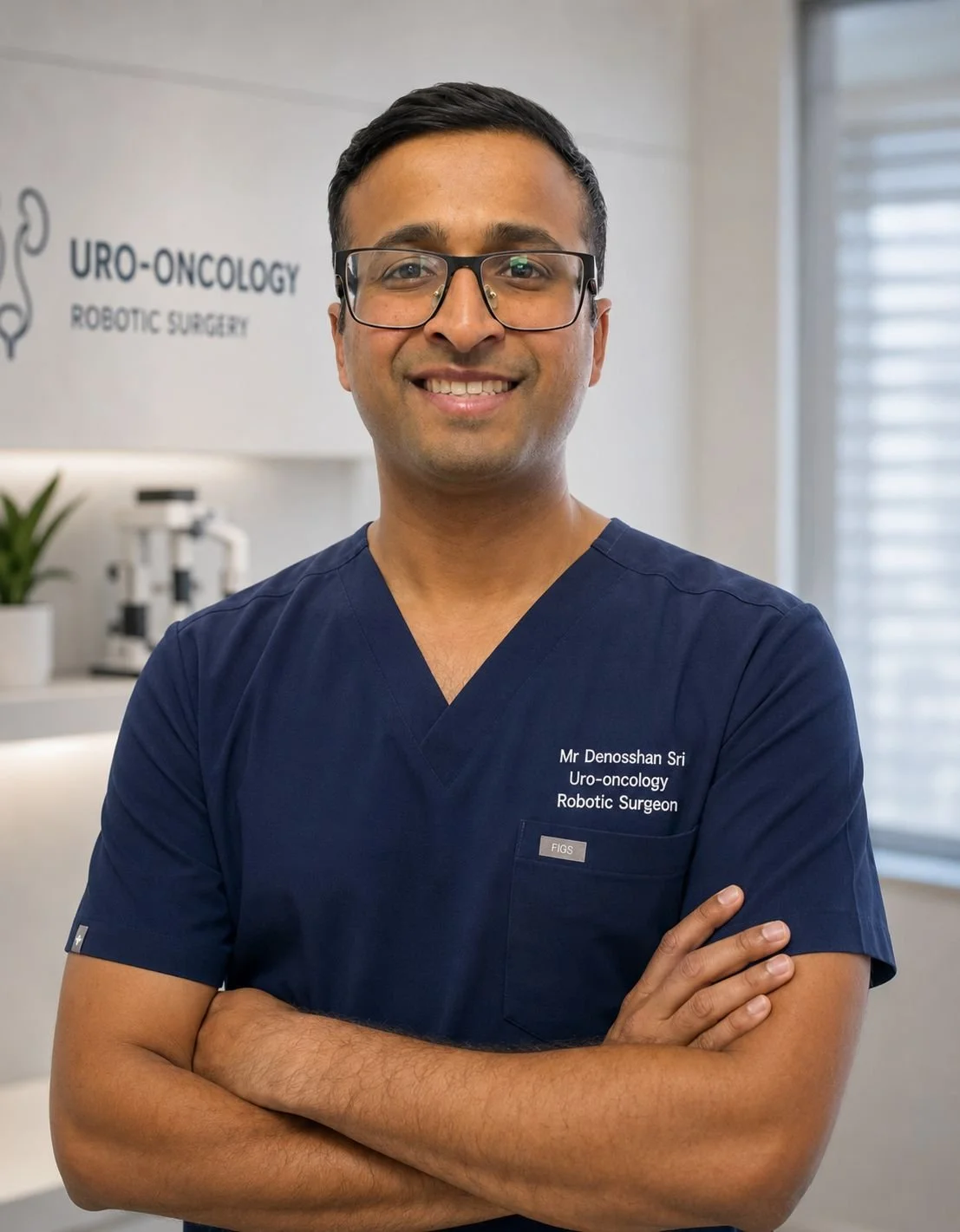
Mr Denosshan Sri
MA Cantab  |  MB BChir  |  FRCS Urol  |  Consultant Urological Surgeon
Mr Sri performs over 200 robotic procedures annually at St George's University Hospital, where he leads the RCS-accredited robotic surgical fellowship and serves as Urology Cancer Lead. He is Principal Investigator of the ELLIPSE trial (RARP vs RARP with lymph node dissection for high-risk prostate cancer). His Surrey private practice is held at Spire St Anthony's Hospital, Cheam and Nuffield Health Parkside, Wimbledon.

Clinic locations

Spire Healthcare
Surrey · Free parking
St Anthony's Hospital, Cheam
801 London Road, Cheam, Surrey SM3 9DW
Tel: 020 8337 6691
Free on-site parking · M25 J8 · A3 · A24
Book at Spire →
Nuffield Health
Wimbledon · SW19
Parkside Hospital, Wimbledon
53 Parkside, Wimbledon SW19 5NX
Tel: 020 8971 8000
On-site parking · A3 · Wimbledon station
Book at Nuffield →
HCA Healthcare UK
Princess Grace Hospital, Marylebone
18 Devonshire Street, London W1G 7AF
Tel: 020 3797 7248
Central London · Near Harley Street
Book at HCA →

Prostate cancer surgery in Surrey & South West London

Same-week appointments at Spire St Anthony's, Cheam or Nuffield Health Parkside, Wimbledon. No GP referral required. All major insurers and self-pay.