
Vasectomy — what to expect before, during, and after
A vasectomy is one of the most reliable forms of permanent contraception available. This guide covers the full process clearly — from the initial consultation through recovery to confirmation of success.
Choosing a permanent method of contraception is a serious decision, and clarity matters. A vasectomy is a minimally invasive procedure that stops sperm from mixing with semen, making pregnancy far less likely once the treatment has been confirmed as successful.
In UK practice, it is usually a minor day-case procedure, often carried out under local anaesthetic. The key point is simple: it does not work straight away. Sperm can still remain in the tubes for a time, so contraception must continue until follow-up semen testing confirms success.
Vasectomy timeline: what usually happens
A straightforward overview can make the whole process feel more manageable.
| Stage | What usually happens | What to remember |
|---|---|---|
| Before the procedure | Consultation, consent, medical history review, preparation advice | A vasectomy should be treated as permanent contraception |
| On the day | Local anaesthetic is common, with some settings also offering general anaesthetic | Usually a day-case — most people go home the same day |
| First few days | Soreness, swelling and bruising are common | Rest and supportive underwear can help significantly |
| First 1–2 weeks | Gradual recovery and return to normal activity | Avoid rushing back to strenuous exercise |
| 12–16 weeks | Semen analysis checks whether sperm are still present | Keep using contraception until told it is safe to stop |
Preparation before the procedure
Preparation starts well before the appointment itself. A consultation will usually cover your medical history, any medicines you take, whether you have had previous surgery in the area, and the fact that vasectomy should be viewed as a permanent choice. This is also the time to talk through concerns about pain, recovery, sex, sport, work, and when follow-up testing will happen.
Many vasectomies are carried out under local anaesthetic, which numbs the area while you remain awake. Some providers may also offer general anaesthetic in selected cases. The right option depends on the clinical setting, your health, and the advice you are given.
- Shower or bath on the morning of the procedure
- Wear supportive pants or snug underwear
- Loose, comfortable trousers
- Plan time away from heavy work
- Arrange a lift home if your clinic advises it
What happens during the procedure
Most people want to know one thing above all: what will it actually feel like?
The area is numbed with anaesthetic first, so the aim is to prevent pain during the procedure itself. You may still notice pressure, movement, or a brief pulling sensation, but sharp pain should not be expected. If you do feel pain, the clinician can usually give more anaesthetic.
During the procedure, the tubes that carry sperm from the testicles — called the vas deferens — are identified through a small opening in the skin. They are then cut and sealed, tied, or blocked so sperm can no longer travel into the semen. In many cases, the procedure is completed within about 15 to 30 minutes, though the full appointment may take longer with preparation and recovery time included.
Most people are surprised by how routine the appointment feels once it begins. The local anaesthetic works effectively, and the procedure itself is far less daunting than many patients anticipate.
It is also worth understanding what a vasectomy does not change. You will still ejaculate after the procedure, and sexual function is not altered. What changes — once the vasectomy has been confirmed to have worked — is the sperm content of the semen.
Erections and orgasm are not stopped by a vasectomy
Ejaculation continues normally after sex or masturbation
Testosterone production continues as normal
Sex drive is not expected to drop because of the procedure
Recovery and aftercare in the first week
After the numbness wears off, some pain is normal. Testicle pain and swelling for around a week are common, and bruising can also happen. For most people, this settles with rest and time.
The first 48 hours are often the most uncomfortable. Supportive underwear can reduce movement and ease soreness. Many people also find that taking it easy, avoiding long periods on their feet, and following advice on pain relief helps a great deal.
Returning to normal activity should be gradual. Light daily movement is usually fine quite soon, but heavy lifting, intense gym sessions, cycling, contact sport, or physically demanding work may need to wait until you are more comfortable. Sex is usually possible again once soreness has settled — though even then, contraception must continue until follow-up semen testing confirms success.
Book a consultation to discuss whether a vasectomy is right for you and what to expect at each stage.
When to seek medical advice
Vasectomy is usually a very safe type of surgery, and serious side effects are rare. Even so, it is sensible to know which symptoms deserve a call to your clinic, GP, or urgent care service.
Most swelling and bruising improve steadily. What matters is the direction of travel. If symptoms are clearly getting worse rather than better, or you feel generally unwell, it is best to ask for advice rather than wait and hope.
- Increasing redness or heat — this can suggest infection
- Fever or feeling generally unwell — should be checked promptly
- Swelling that keeps worsening — a review may be needed
- Severe pain not settling — especially if pain relief is not helping
- Persistent bleeding or discharge — the wound may need attention
When a vasectomy becomes effective
This is the part many people do not expect. A vasectomy does not clear existing sperm from the system on the day it is done. Sperm can remain in the tubes above the point where the vas deferens has been sealed, which means pregnancy is still possible for a time afterwards.
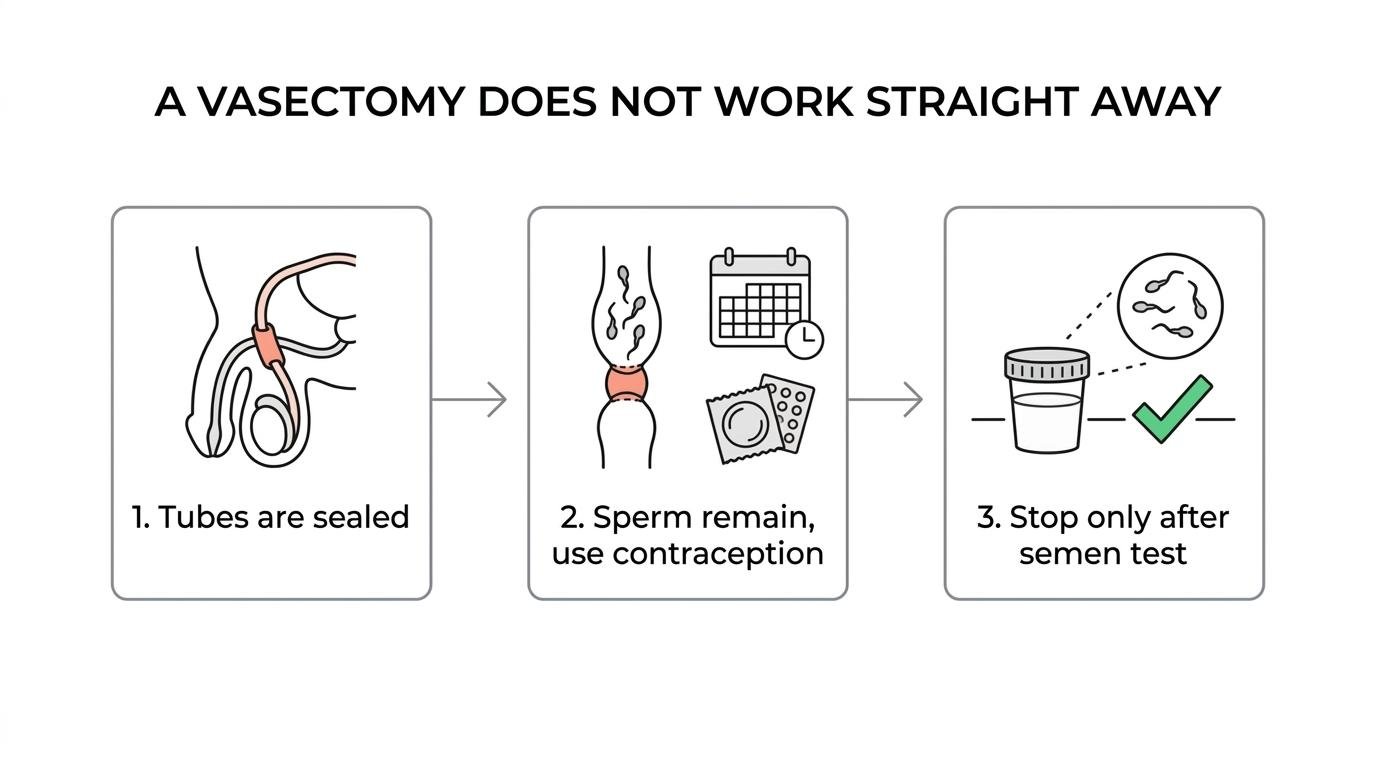
That is why contraception must continue until semen testing confirms that sperm are no longer present. In UK practice, semen analysis is often arranged at around 12 to 16 weeks after the procedure. Some people will need more than one sample before the result is clear.
This follow-up is not a formality. It is the step that confirms the treatment has actually worked.
If sperm are still found, you may be asked to continue contraception and repeat the test later. In a small number of cases, further review is needed. Rarely, a vasectomy can fail if the cut ends of the tube rejoin.
Risks and complications to know about
Vasectomy has a strong safety record, and for most people the recovery is straightforward. Still, every procedure has potential downsides, and being informed helps you make a calm, confident choice.
Common short-term issues include soreness, bruising, swelling, minor bleeding, and tenderness in the scrotum. Less common problems can include infection, a collection of blood inside the scrotum (haematoma), or longer-lasting discomfort. Some men experience chronic testicular or scrotal pain after vasectomy, though this is not the usual outcome. There is also a small failure risk, which is why post-procedure semen analysis matters so much.
This does not mean vasectomy is unsafe. It means the decision should be made with open eyes and sensible expectations. For the vast majority of men, the procedure is well tolerated and the recovery is straightforward.
What a vasectomy does not change
Many anxieties around vasectomy are tied to masculinity, sexual confidence, or fears about feeling different afterwards. Most of these concerns reflect anticipation rather than what actually happens in recovery.
A vasectomy does not remove the testicles, lower testosterone, or stop ejaculation. It does not change your voice, physical strength, or core male hormones. Once healing is complete, sex should feel physically much the same for most people. The visible amount of semen is also usually very similar, because sperm make up only a small fraction of it.
A vasectomy changes fertility, not identity.
Is vasectomy the right choice for you?
The most suitable time to consider vasectomy is when you feel certain that you do not want future biological children, or do not want any more. Reversal procedures do exist, but they are not guaranteed to work, and a vasectomy should never be chosen on the assumption that it can easily be undone later.
It can help to give the decision some space. Think about your long-term plans, your age, your family situation, and how you might feel if circumstances changed. Some people are completely sure from the start. Others benefit from a little more time and a second conversation before booking treatment.
- Anaesthetic options — what is offered and what is most suitable for you
- Recovery time — when you can return to work, driving, exercise and sex
- Aftercare — how to look after the area and what symptoms to watch for
- Semen testing — when your sample will be checked and how results are given
- Permanence — whether vasectomy fits your future plans with confidence
A well-informed decision tends to feel calmer, clearer and easier to stand behind. For many people, that is exactly what makes vasectomy such a strong long-term contraceptive option.