
Understanding bladder cancer — warning signs and blood in urine
Blood in the urine is the most consistent warning sign of bladder cancer. One episode — even if it stops — is enough to seek urgent assessment. This guide explains the diagnosis pathway, what cystoscopy and TURBT involve, and how treatment is matched to stage.
Bladder cancer starts in the tissues of the bladder — the hollow organ that stores urine before it leaves the body. It is a condition that often comes to attention because of a very clear warning sign: blood in the urine, also called haematuria. That symptom can be caused by several conditions, many of them not cancer, yet it always deserves prompt medical assessment.
Early assessment matters because it leads to the right investigations, a clear diagnosis, and a treatment plan built around the stage of the disease. In many cases, the path from first symptom to confirmed diagnosis involves cystoscopy and a procedure called TURBT — with surgery forming the backbone of treatment for many patients.
One episode of visible blood in the urine is enough to justify urgent assessment — even if it clears on its own, even if it is painless, and even if it does not happen again.
What bladder cancer is and where it starts
Most bladder cancers begin in the inner lining of the bladder. The most common type is urothelial carcinoma, which develops from the cells lining the urinary tract. Some tumours remain close to the surface, while others grow deeper into the bladder wall.
This difference is central to treatment planning. Doctors group bladder cancer into two broad categories based on depth of invasion:
- Non-muscle-invasive bladder cancer (NMIBC) — the tumour has not grown into the bladder muscle. This accounts for around 75% of new diagnoses and is generally more treatable.
- Muscle-invasive bladder cancer (MIBC) — the tumour has grown through the bladder muscle. This requires more intensive treatment and carries a higher risk of spread.
That split has a major effect on what comes next — from local endoscopic treatment to more extensive surgery, radiotherapy, or systemic treatment. Bladder cancer can appear with obvious symptoms, though some cases are found incidentally during investigation of another problem.
Blood in urine and other warning signs
Blood in the urine is the single most consistent warning sign. It may be bright red, pink, or rusty brown. It may happen once and then clear, or come and go over days or weeks. Painless visible haematuria — blood without discomfort — has the highest association with urological malignancy and should never be assumed to be trivial.
If you notice blood in your urine, ask for an urgent GP appointment or use NHS 111 — even if the bleeding stops. Do not wait for it to happen again. Mr Sri offers same-week haematuria assessment at four London locations.
Other symptoms that can accompany or precede a diagnosis include:
- Visible blood in the urine — the most important single symptom
- Passing urine more often than usual
- Pain or burning when passing urine
- Waking at night to pass urine (nocturia)
- A strong or sudden urge to pass urine
- Pelvic discomfort
These urinary symptoms can also be caused by infection, bladder stones, or other benign conditions — which is why direct investigation is essential rather than treating symptoms empirically and hoping they clear.
Diagnosis — the pathway from symptom to confirmation
Assessment starts with a review of symptoms, medical history, and risk factors. A clinician will ask about smoking history (the single strongest modifiable risk factor), previous bladder problems, occupational chemical exposure, and family history. Urine tests are part of the initial stage, though they cannot by themselves confirm or rule out bladder cancer.
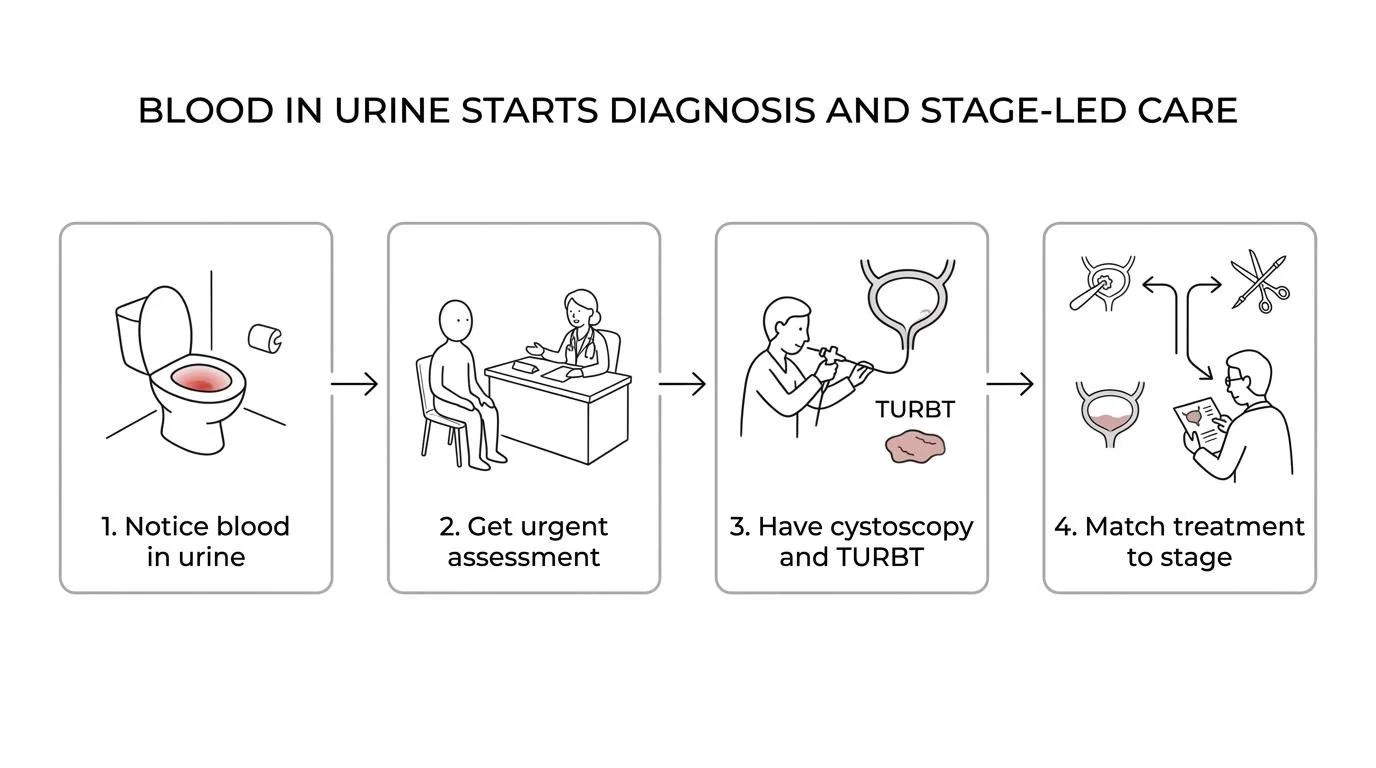
When bladder cancer is suspected, cystoscopy is the key investigation. NICE guidance specifies that when a urologist considers bladder cancer possible, cystoscopy should be offered to allow direct visual inspection of the bladder lining. This provides information that cannot be matched by imaging or urine tests alone.
| Diagnostic step | What it involves | Why it matters |
|---|---|---|
| Medical review & urine tests | Symptoms, history, urine sample, urine microscopy and cytology | Identifies infection, stones, and flags cytological abnormality |
| Cystoscopy | A thin camera passed through the urethra to inspect the bladder directly | Gives a direct view of suspicious areas — cannot be replaced by scans alone |
| Imaging (CT urogram) | Cross-sectional imaging of the kidneys, ureters, and bladder | Checks the upper urinary tract and assesses for possible spread |
| TURBT | Endoscopic removal or sampling of bladder tumour tissue under anaesthetic | Confirms diagnosis and stages how deeply the cancer has grown |
| Pathology analysis | Laboratory examination of removed tissue | Defines tumour type, grade, and features that shape all subsequent decisions |
What cystoscopy and TURBT mean in practice
Cystoscopy is usually done as an outpatient or day-case procedure. A flexible cystoscope — a thin tube with a camera — is passed through the urethra into the bladder. It sounds daunting, but it is a standard investigation and gives information that cannot be replaced by symptoms or scans.
If an abnormal area is found, TURBT follows. This stands for transurethral resection of bladder tumour. Under anaesthetic, a surgeon passes instruments through the urethra to remove the suspicious area from inside the bladder. The tissue goes to a laboratory pathologist, who determines whether cancer is present, the tumour grade (how aggressive the cells appear), and crucially — how deep the cancer has grown. That depth determines whether the tumour is non-muscle-invasive or muscle-invasive, and therefore what treatment comes next.
TURBT is often both diagnostic and therapeutic — it can remove the visible tumour at the same time as confirming the diagnosis.
Mr Sri offers same-week haematuria assessment including urine tests, imaging referral, and flexible cystoscopy where indicated. No GP referral required.
Treatment — matched to stage
Treatment depends on stage, grade, general health, and personal priorities. Surgery is the foundation of care for many patients, but what that looks like varies substantially between early and advanced disease.
Non-muscle-invasive
TURBT to remove the tumour. Intravesical therapy (BCG or chemotherapy into the bladder) may follow to reduce recurrence risk. Regular cystoscopic surveillance is standard.
Muscle-invasive (localised)
Radical cystectomy (bladder removal) or bladder-preserving chemoradiotherapy in selected patients. Neoadjuvant chemotherapy before surgery is considered for eligible patients.
Advanced / metastatic
Systemic treatment — immunotherapy and targeted agents have substantially improved outcomes. Symptom control and specialist support are central to care at this stage.
For non-muscle-invasive disease, the focus is on removing the tumour and reducing the chance of recurrence. Bladder tumours can come back even after successful treatment, which is why regular cystoscopic follow-up is not optional — it is the mechanism by which recurrence is caught early when it is most treatable.
For muscle-invasive localised disease, radical cystectomy — surgical removal of the bladder — remains the most definitive treatment for eligible patients. Urinary diversion is created at the same operation, and the form this takes is discussed carefully beforehand. Bladder-preserving approaches using concurrent chemotherapy and radiotherapy offer an alternative for selected patients who are unsuitable for or choose to avoid surgery.
Follow-up and what to watch for
Follow-up is a major and ongoing part of bladder cancer care. Even when the first treatment is successful, cystoscopic surveillance continues at defined intervals. The frequency typically reduces over time if the bladder remains clear, but it rarely stops entirely for non-muscle-invasive disease.
After TURBT, recovery is usually relatively quick — temporary discomfort, mild bleeding, or urinary irritation are common and settle within days to weeks. Recovery after radical cystectomy or radiotherapy is more demanding and involves longer-term adjustment.
During follow-up, report any new or returning symptoms promptly:
- Blood in the urine — always report, even between scheduled appointments
- Worsening urgency or frequency
- Pain when passing urine
- Pelvic pain or lower back pain
- Unexplained weight loss
- Increasing fatigue
A second opinion after diagnosis is entirely appropriate — particularly when treatment choices are complex, staging is unclear, or you want to compare options before committing to a treatment plan. Mr Sri sees patients at four London locations and accepts referrals for second opinion consultations.