
Stress urinary incontinence can have a quiet but persistent effect on daily life. A cough, a brisk walk, a gym session, or even a laugh may trigger urine leakage — and over time, that can chip away at confidence in ways that are hard to quantify but very real to live with.
When pelvic floor rehabilitation and other non-surgical measures have not brought enough relief, surgery may become part of the conversation. One option in that surgical pathway is colposuspension — a well-established mesh-free procedure that supports the bladder neck and urethra. A newer version of that operation uses robotic assistance, combining the proven principle of the Burch procedure with the precision and minimally invasive advantages of keyhole surgery.
At our practice, robotic colposuspension is performed jointly by Mr Denosshan Sri (robotic and pelvic surgical expertise) and Mr Jai Seth (female and functional urology expertise) — ensuring that both robotic technical skill and specialist continence assessment are present throughout the procedure. This dual-consultant approach is a deliberate quality decision for complex pelvic surgery.
What stress urinary incontinence is and where colposuspension fits
Stress urinary incontinence happens when pressure inside the abdomen rises and the support around the urethra is not strong enough to keep urine in. The leak is linked to exertion — it is a mechanical problem, not a problem of the bladder's urge to empty. In many women, it first becomes noticeable after pregnancy, childbirth, menopause, pelvic surgery, or through age-related changes in tissue support.
Common triggers include coughing or sneezing, running or jumping, lifting, laughing, and changing position quickly. The pattern of symptoms is important: a thorough urological and pelvic assessment — including urodynamic studies where appropriate — should precede any surgical discussion.
NICE guidance places surgery after non-surgical treatment has been tried and has not worked well enough. At that point, women may be offered a choice that can include colposuspension (open or laparoscopic), or an autologous rectus fascial sling. Colposuspension is a recognised mesh-free surgical option — an important distinction given the scrutiny mesh procedures have rightly received.
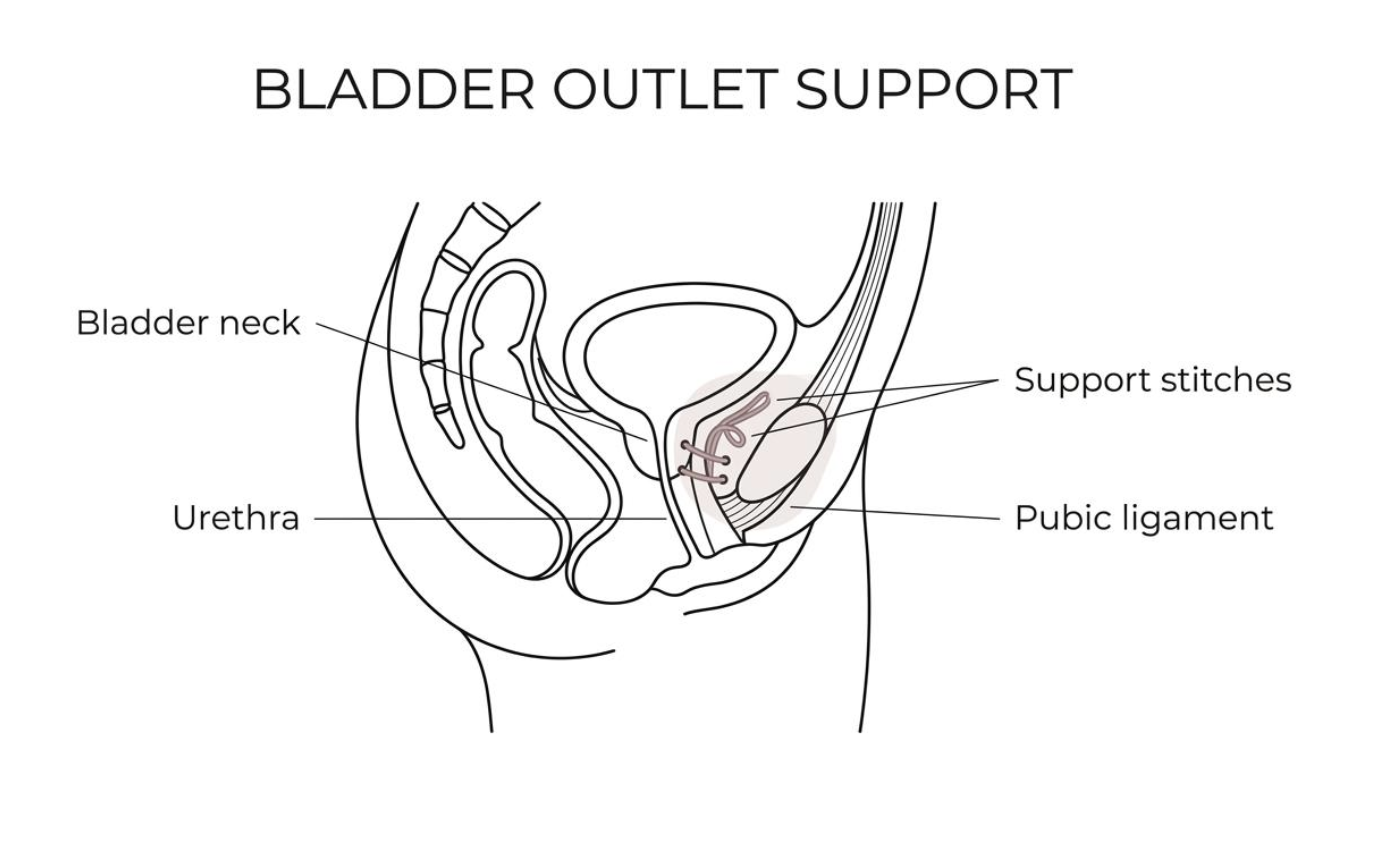
How robotic-assisted colposuspension works
The best-known form of colposuspension is the Burch procedure. In the traditional open operation, sutures are placed in the paravaginal tissue beside the bladder neck and urethra, then attached to the iliopectineal (Cooper's) ligament behind the pubic bone. This lifts and supports the outlet of the bladder — reducing the chance of leakage when abdominal pressure rises.
The robotic-assisted version follows exactly the same surgical aim. What changes is how the surgeon reaches the operating field. Instead of one larger abdominal incision, several small port incisions are made. Through these, a high-definition three-dimensional camera and robotic instruments are inserted. The operating surgeon sits at a console and controls the robotic arms in real time — the robot does not act independently. It translates the surgeon's hand movements into precise, scaled-down instrument movements inside the pelvis.
This approach is particularly well suited to colposuspension because suturing accurately in a confined retroperitoneal space is one of the most technically demanding parts of the procedure. Robotic instruments offer a greater range of motion than standard straight laparoscopic tools, and the magnified three-dimensional view aids precision when working around delicate pelvic structures.
Colposuspension uses only sutures and the patient's own native tissues. There is no synthetic mesh. For women who want a durable, evidence-based, mesh-free incontinence operation, colposuspension remains one of the strongest options within NICE guidance — and the robotic version delivers it through keyhole incisions.
The surgical team — combined robotic and functional urology expertise


Having both surgical perspectives present is a deliberate clinical decision. Complex pelvic surgery benefits from robotic technical precision alongside specialist continence assessment — these are distinct skills, and combining them in a single operating team is what makes this service possible at the level it is offered.
How robotic colposuspension compares with other approaches
Colposuspension can be performed in more than one way, and the choice depends on surgical expertise, the patient's previous operations, overall health, and what matters most to the individual.
| Approach | How it is done | Recovery profile | Evidence base |
|---|---|---|---|
| Open colposuspension | One larger lower abdominal incision | Longer recovery; typically 2–4 days in hospital | Strongest long-term evidence — decades of comparative data; Cochrane review of 55 trials |
| Laparoscopic colposuspension | Keyhole surgery with straight instruments | Often quicker than open surgery; shorter stay | Recognised in NICE guidance; smaller evidence base than open |
| Robotic-assisted colposuspension | Keyhole surgery with surgeon-controlled robotic instruments | Minimally invasive; typically 1–2 days; 20 ml mean blood loss (published series) | Promising early series; pioneered in the UK by this team — evidence growing |
| Autologous rectus fascial sling | Sling fashioned from the patient's own abdominal fascia | Longer recovery; mesh-free alternative | Recognised in NICE guidance; NICE notes no clear short/medium-term difference vs colposuspension |
NICE notes that evidence has not shown important short- or medium-term differences in effectiveness between colposuspension, retropubic mid-urethral mesh slings, and autologous fascial slings — placing colposuspension as a fully valid option within established surgical care. The robotic variation is closest to the laparoscopic route in recovery profile, while offering technical advantages for intracorporeal suturing.
What the current evidence shows
A prospective series published in 2022 reported outcomes for 28 women who underwent robotic-assisted laparoscopic colposuspension. At a mean follow-up of 12 months, mean ICIQ-UI-SF scores improved from 18.1 to 9.4 — a meaningful reduction in symptom burden — alongside the 73% improvement in 24-hour pad use.
The contrast with open surgery in scale is honest and worth stating: the Cochrane review of open retropubic colposuspension included 55 trials and more than 5,400 women, with overall cure rates from 68.9% to 88.0%. The robotic variation is based on the same underlying surgical principle, but its published dataset is smaller and follow-up shorter. Early results are encouraging — and the series continues to grow.
Who may be considered for robotic colposuspension
This operation is generally considered for women with stress urinary incontinence that remains bothersome after non-surgical care has been given a proper trial. It may also appeal to those who want a mesh-free operation and are suitable for an abdominal keyhole approach.
Selection is individual. The decision rests on the pattern of leakage, urodynamic findings, pelvic examination, past operations, overall fitness for anaesthetic, and the priorities of the patient herself. Some women will be better served by open colposuspension, a fascial sling, or continuing non-surgical management — and that is always stated clearly in the consultation.
Factors that usually shape the conversation include whether the leakage is genuinely stress-type rather than urgency-related; whether non-surgical measures — pelvic floor training, medication — have been given a proper trial; whether a mesh-free approach is preferred; and whether there has been previous pelvic surgery that might affect access or anatomy.
Considering robotic colposuspension for stress incontinence?
Mr Sri and Mr Jai Seth offer joint assessment and surgery for stress urinary incontinence. Same-week appointments available. No GP referral required for a private consultation.
What recovery looks like
Robotic colposuspension is performed under general anaesthetic. Small abdominal port incisions are made, the retroperitoneal space is carefully developed, and supporting sutures are placed beside the bladder neck and urethra. A urinary catheter is in place during and after the operation while the bladder settles.
One well-recognised side effect of colposuspension is difficulty emptying the bladder fully after surgery — a consequence of the bladder neck support created by the procedure. Some women need the catheter for longer or temporary support while normal voiding returns. This is discussed in detail as part of the pre-operative consent.
Questions worth asking before deciding
A well-informed decision is a calmer one. The most useful questions connect the technology to the individual's own pattern of symptoms, previous history, and goals.
- Is my incontinence genuinely stress-type — and has urodynamic testing been done to confirm this?
- Have I had a proper trial of pelvic floor rehabilitation — and if so, what did it achieve?
- How does robotic colposuspension compare with open colposuspension or a fascial sling in my specific case?
- What happens if bladder emptying is slow after surgery — and how long might a catheter be needed?
- What are your published results for this procedure — and what is the local experience of the operating team?
- How long before I can return to work, drive, and exercise normally?
- What is the follow-up plan — and who should I contact if symptoms persist or change?
NHS Kidney Cancer Lead and RCS Robotic Fellowship Lead at St George's University Hospitals. Mr Sri provides the robotic surgical platform and pelvic expertise for the robotic colposuspension programme, working alongside Mr Jai Seth in a joint surgical team. Full profile and publications →
Female and functional urology specialist at Nuffield Health Parkside, Kingston Hospital Private Health, New Victoria Hospital, and King Edward VII's Hospital. Led the team that pioneered robotic colposuspension in the UK, presenting the programme at the BAUS 2022 annual conference. Co-author of over 40 peer-reviewed publications. Provides the specialist continence assessment and female urology expertise in the joint operating team. londonbladder.co.uk →