Male Contraception · London
Vasectomy — Private Specialist,
London
A highly effective and permanent form of contraception, performed by a consultant urological surgeon using a minimally invasive technique under local or general anaesthetic.
Book a Consultation
Send an Enquiry
QualificationMA Cantab · MB BChir · FRCS Urol
Techniquegeneral or local anaesthetic
SettingDay case · same-day discharge
InsuranceSelf-pay · some insurers
Please read before booking: Vasectomy is intended to be a permanent procedure. While reversal is surgically possible, it cannot be guaranteed to restore fertility — and should not be planned for. The decision to proceed should only be made when both partners (where applicable) are certain that their family is complete. A pre-operative consultation is mandatory and gives you the opportunity to ask all questions before committing to proceed.
What is a vasectomy?
A vasectomy is a minor surgical procedure that divides and occludes the vas deferens — the tubes that carry sperm from the testes to the urethra. By interrupting this pathway, sperm can no longer be included in the ejaculate, making the procedure a highly effective and permanent form of contraception.
Vasectomy does not affect testosterone levels, sex drive, erection, or ejaculation. The ejaculate continues to look and feel the same — the only difference is the absence of sperm. The procedure has no effect on the sensation of orgasm.
The procedure — what to expect
Before the procedure
A pre-operative consultation is arranged to discuss the procedure, confirm your decision, and answer all questions. Please shower on the morning of your appointment, shave your scrotum where needed and wear or bring close-fitting underwear for support afterwards. Avoid taking aspirin or blood thinners in the days before unless prescribed by your doctor.
On the day
The procedure is performed under local or general anaesthetic. The scrotal skin is cleaned and numbed with a local anaesthetic injection — the only part of the procedure that may cause brief discomfort. The procedure itself typically takes 15–30 minutes. You can go home shortly afterwards.
The technique
A small puncture or cut is made in the scrotal skin. The vas deferens on each side is identified, brought to the surface, divided, and the ends are sealed. They are then buried in different fascial planes (fascial interposition). The skin is closed.
Immediately after
You will need someone to drive you home. Wear close-fitting supportive underwear for 48 hours. Rest for the remainder of the day. Mild scrotal discomfort, bruising, and swelling are normal and settle within a few days. Simple paracetamol or ibuprofen is usually sufficient for pain relief.
Recovery timeline
Rest and support
Rest at home. Wear supportive underwear. Mild bruising and swelling is normal. Avoid strenuous activity, heavy lifting, and sexual activity.
Return to light activity
Most men return to sedentary work within 2–3 days and feel comfortable resuming light activity by the end of the first week. Avoid swimming or immersing the area in water until fully healed.
Resume sexual activity
Sexual activity can typically be resumed after one week, once comfortable. Continue to use contraception — the vasectomy is not immediately effective and sperm may remain in the reproductive tract for several weeks or months.
Return to full activity
Strenuous exercise, manual work, and heavy lifting can be resumed once fully comfortable — typically at 2–4 weeks. Continue using contraception until clearance is confirmed by semen analysis.
Semen analysis — confirming success
A semen analysis is performed at 12–16 weeks after the procedure. This is the essential final step that confirms the vasectomy has been successful. Contraception must be continued until clearance is confirmed — the procedure is not considered complete until a satisfactory semen analysis result has been received.
Semen analysis — what you need to know
Semen analysis at 12–16 weeks — this step is essential
Do not stop contraception until you have received a satisfactory result
A semen sample is produced at home and submitted to a laboratory for analysis at 12–16 weeks after the procedure. The sample must be produced after a minimum of 20 ejaculations since the vasectomy, to allow the reproductive tract to clear residual sperm. This is the only reliable way to confirm that the vasectomy has been effective.
For self-paying patients: the laboratory analysis fee is charged separately by the laboratory and is not included in the procedure cost. Mr Sri's team will provide details of the preferred laboratory and the submission process at your follow-up. The additional cost is typically modest and paid directly to the lab.
Results are reviewed by Mr Sri and communicated to you with a clear recommendation. In the majority of cases, a single satisfactory semen analysis confirming azoospermia (no sperm) or very low counts is sufficient for clearance.
Special clearance — what this means
In a small proportion of men — typically those with rare non-motile sperm remaining in the sample beyond the standard timeframe — a second opinion from a specialist laboratory or a further sample at a later stage may be required before clearance can be issued. This is known as special clearance.
Special clearance does not mean the vasectomy has failed. It reflects the biological reality that non-motile (immotile) sperm may persist for longer in a minority of men without posing a meaningful risk of pregnancy. Nationally agreed guidelines — published by the British Andrology Society and the British Association of Urological Surgeons — define the criteria for special clearance, and Mr Sri follows these in his practice.
If special clearance applies to you, this will be explained clearly at the time, with a detailed explanation of what it means for you and your partner and what, if anything, further follow-up is required.
Risks and complications
Vasectomy is a safe and well-established procedure, but — like all surgical procedures — carries a small risk of complications. These are discussed fully at your pre-operative consultation.
Haematoma
Bleeding into the scrotum causing swelling and bruising. Occurs in approximately 1–2% of cases. Usually resolves without intervention. Minimised by small incision and post-operative support.
Infection
Wound or epididymal infection is uncommon (<1%). Treated with antibiotics if it occurs. Good hygiene and avoiding water immersion in the early recovery period reduces risk.
Chronic scrotal pain
A small number of men (1–2%) develop persistent scrotal discomfort after vasectomy. This is usually mild and manageable. Severe post-vasectomy pain syndrome is rare but should be discussed at the pre-operative consultation.
Failure
Vasectomy fails to achieve azoospermia in approximately 1 in 2,000 cases due to spontaneous reconnection of the vas. This is why semen analysis at 12–16 weeks is essential — it is the safety check that identifies this rare occurrence before contraception is discontinued.
Frequently asked questions
Does a vasectomy hurt?
The local anaesthetic injection causes brief stinging, which patients typically describe as the most uncomfortable part. The procedure itself is not painful — you may feel pressure or pulling, but not sharp pain. Post-operative discomfort is mild and well controlled with simple analgesia for 1–2 days.
When can I stop using contraception?
Only once you have received a satisfactory semen analysis result confirming clearance — not before. This cannot be assumed from the procedure alone. The semen analysis at 12–16 weeks (after at least 20 ejaculations) is the definitive confirmation. Until then, contraception must be continued.
Will a vasectomy affect my sex life?
No. Testosterone production, sex drive, erection, and orgasm are entirely unaffected. The ejaculate continues to look and feel the same — the volume of sperm within it is negligible and imperceptible. Many couples report that the removal of contraceptive anxiety has a positive effect on their sex life.
Can a vasectomy be reversed?
Vasectomy reversal (vasovasostomy) is technically possible but should not be planned for. Success rates decline significantly with time since vasectomy, and reversal is not available on the NHS. A vasectomy must be considered permanent. This is why the pre-operative consultation places emphasis on the permanence of the decision before proceeding.
What does special clearance mean — am I still protected?
Special clearance applies when rare non-motile (non-swimming) sperm are still present in the sample. Non-motile sperm cannot fertilise an egg, so special clearance represents a successful vasectomy for the purposes of contraception, in line with British Andrology Society guidelines. Mr Sri will explain clearly whether special clearance applies and what it means for you.
Do I need a GP referral?
No — you can book directly. A pre-operative consultation is always arranged before the procedure to discuss the decision fully, review your medical history, and answer all questions. Both partners are welcome to attend this appointment.
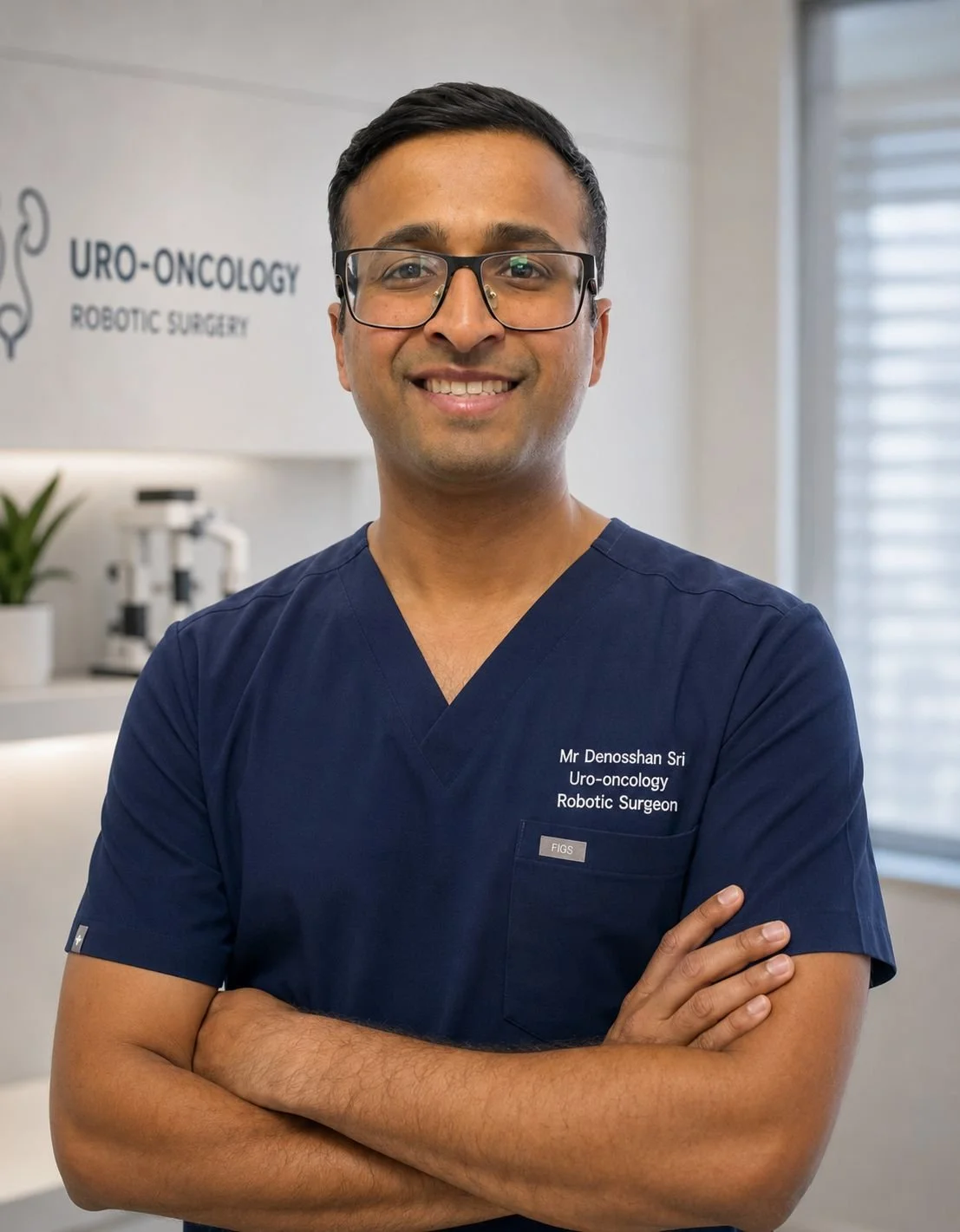
Mr Denosshan Sri
MA Cantab | MB BChir | FRCS Urol | Consultant Urological Surgeon
Mr Sri performs vasectomy under local or general anaesthetic as a day-case procedure. As a consultant urological surgeon, he brings the same rigour and attention to detail to vasectomy as to his complex reconstructive and oncological practice. All patients receive a pre-operative consultation, post-operative guidance, and direct access to Mr Sri's team throughout the recovery period and at the point of semen analysis review. He sees patients at three private hospital locations in London and Surrey.
Clinic locations
Spire St Anthony's
801 London Road
Cheam, Surrey SM3 9DW
Tel: 020 8337 6691
Nuffield Parkside
53 Parkside
Wimbledon SW19 5NX
Tel: 020 8971 8000
HCA Princess Grace
18 Devonshire Street
Marylebone W1G 7AF
Tel: 020 379 77248
